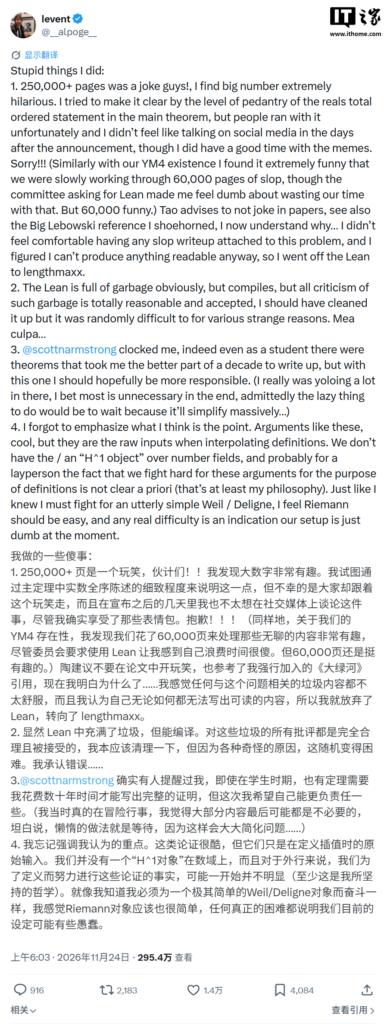
Mathematician Levent Alpöge said on November 23, 2026, that his claim about a more-than-250,000-page explanation of a Claude-assisted proof of the Riemann hypothesis was a joke. He acknowledged that readers had taken it seriously and that he had not clarified it in the days after publishing his work.
On November 20, Alpöge had posted a four-page note on his website saying that he and Claude had found a proof of the Riemann hypothesis using a method that also covered the generalized Riemann hypothesis. Rather than release a conventional paper, he made the proof available as Lean code, which a computer can check step by step. As The Conversation reported, Alpöge had said an AI-generated English explanation ran to more than 250,000 pages and would be unsuitable to publish.
Alpöge now says he never intended to release such a vast readable proof. He also acknowledged that the public Lean code was full of unnecessary material, while saying it compiled successfully. He called criticism of its condition fair and said he should have cleaned it up before publication. In response to mathematician Scott N. Armstrong’s criticism of his working habits, Alpöge said much of the material may ultimately prove unnecessary and could be substantially simplified.
Alpöge did not say he was withdrawing the proof. Lean FRO and the Mathlib Initiative said in a November 21 joint statement that they had strong confidence in it. According to the two organizations, the code compiled, used a theorem consistent with Mathlib’s verified definition of the Riemann hypothesis, and passed checks by Lean’s official kernel and several independent proof checkers. Those are the organizations’ reported verification findings; Alpöge’s clarification concerned the page-count claim and the presentation of the code.