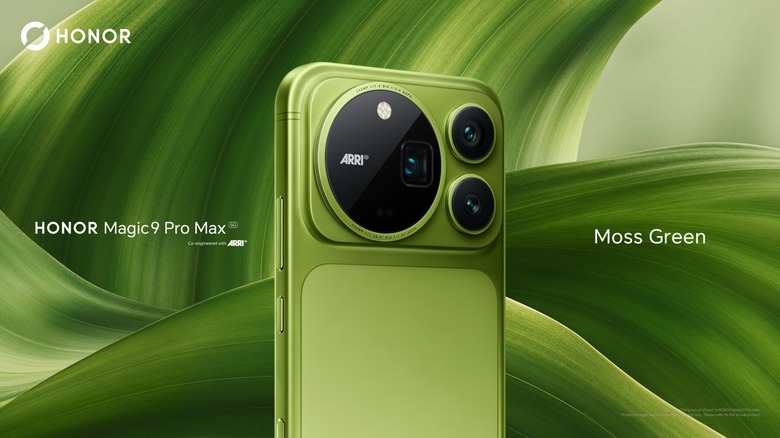
Honor’s Magic 9 Pro Max is the company’s first full flagship to use its partnership with Arri, the German maker of the Alexa cinema camera, and only the second Honor phone after the Robot Phone to draw on that collaboration. Alexa cameras have been used to shoot at least six films that later won the Academy Award for cinematography.
The Magic 9 Pro Max is also the first Honor flagship to use an industrial design previously seen on the company’s lower-end N series. That design includes a new camera plateau and a contrasting back panel around the frame. It is the first Honor flagship to carry the Pro Max name.
The phone uses a Snapdragon 8 Elite Extreme Gen 6, with 12GB or 16GB of RAM and 256GB, 512GB, or 1TB of storage. Its display is a 6.8-inch LTPO OLED at 2,868 by 1,320 pixels, with a 1–120Hz refresh rate and a stated peak brightness of 10,000 nits. It has an 8,000mAh battery and supports up to 100W wired charging or 80W wireless charging. Other listed features are Wi-Fi 7, space for two SIM cards plus an eSIM, and a 55-megapixel front camera.
The rear array is described as an Arriflex-inspired triple camera: a 200-megapixel f/1.57 primary camera with optical image stabilization, a 200-megapixel f/2.6 telephoto with OIS, and a 50-megapixel f/2.0 ultrawide. Honor says the primary lens offers what it calls “gimbal” levels of optical stabilization. The company is also introducing its first dedicated imaging processor, the H1, and says the phone uses an end-to-end cinematic workflow. That includes recording in Arri LogC3, Arri-created filters and color profiles, up to 87 Arri looks, and cinema aspect ratios such as 2.39:1.
Honor is offering accessories with SmallRig. A SmallRig camera cage can be used with an Honor-branded Teleconverter G200 or Teleconverter G500, which Honor says increase focal length by 200mm or 500mm for distant shots that would be difficult to capture with AI-enhanced imaging alone.
The Magic 9 Pro Max is launching in Malaysia at RM 5,999 (about $1,455) for the 12GB RAM and 512GB storage model. It is due in the Middle East in December 2026 and in Western markets at some point in January 2027.