Pinterest has replaced a multistage clustering pipeline for identifying users’ longer-term goals with a fine-tuned, 4-billion-parameter language model. In initial A/B tests in the US and Canada, the company reported a 1.1% increase in email click-through rate and a 1.3% increase in push-notification open rate compared with the clustering system.
Pinterest calls these goals journeys: activities across multiple sessions that point to a project rather than separate interests. Someone renovating a kitchen, for example, might search for cabinets, save countertop ideas and later explore tile or lighting.
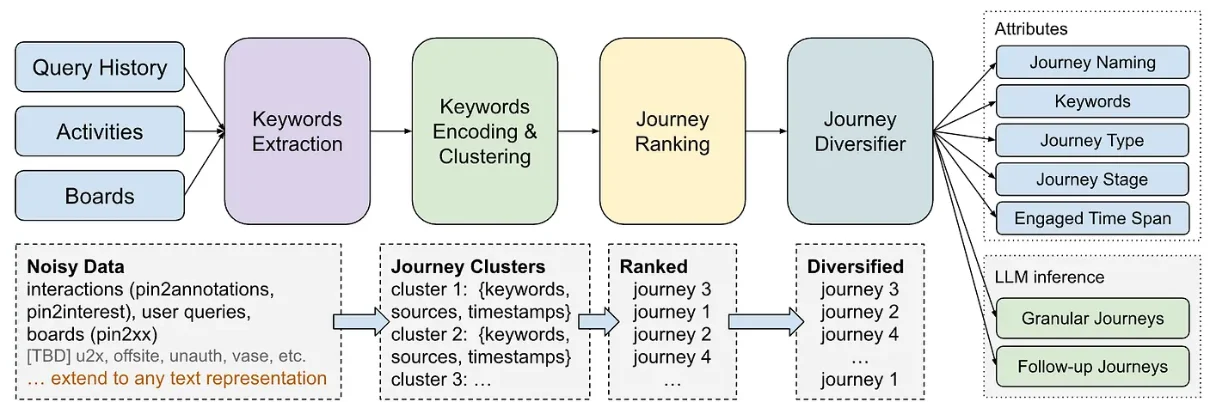
The previous system extracted keywords from user activity, grouped them using embeddings and hierarchical clustering, named the groups, and then ranked and filtered them. Pinterest said it could split related activity into separate journeys or mistake a one-off interaction for sustained intent.
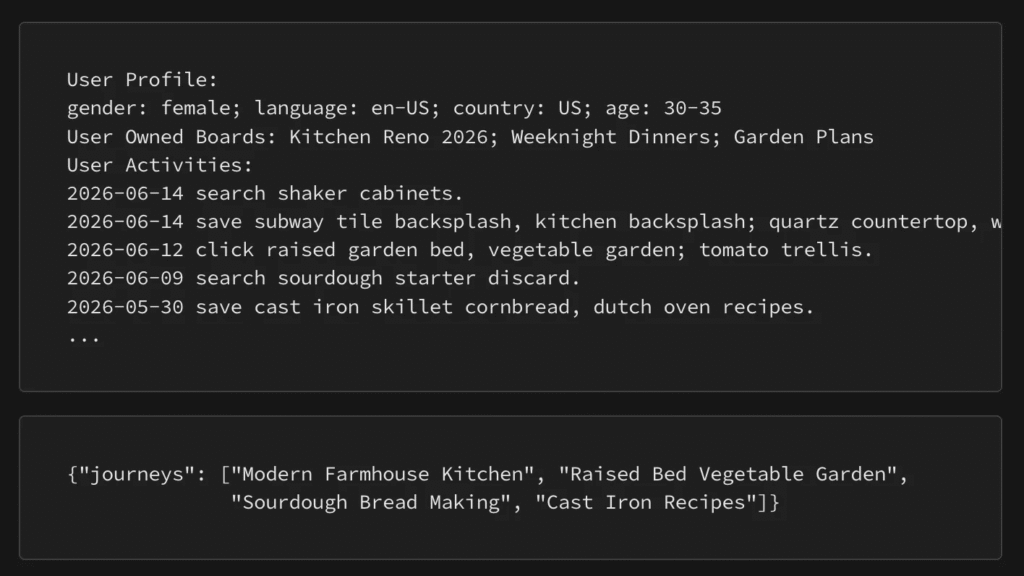
The new model reads a chronological record of up to 150 actions over 360 days, alongside a condensed user profile, and generates a prioritized list of journey names. Its instructions give more weight to searches and saves than incidental clicks. They also tell it to avoid combining unrelated interests and to return no journey when the evidence is insufficient.
Without a large human-labeled dataset, Pinterest used a frontier model to generate synthetic training examples from activity histories. It then used supervised fine-tuning and low-rank adaptation (LoRA) on an open-weight Qwen3 model. After testing models from 600 million to 8 billion parameters, the team selected the 4-billion-parameter version as a balance between inference quality and serving throughput.
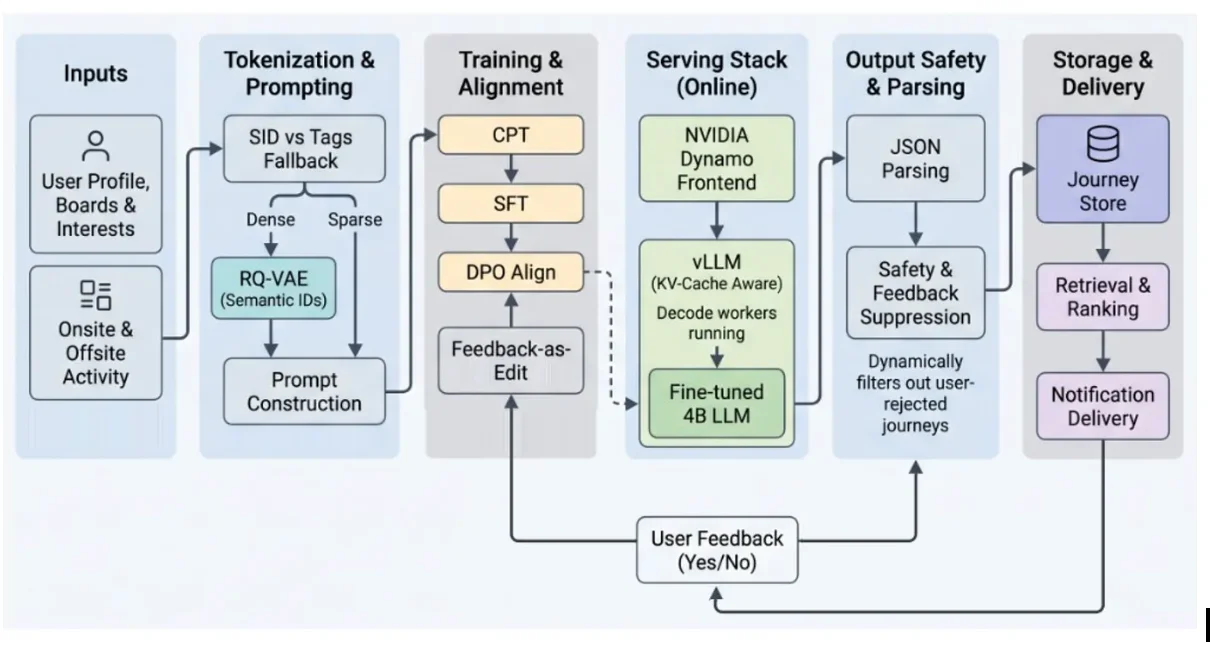
For serving, Pinterest placed NVIDIA Dynamo in front of vLLM workers running on L40S GPUs and used techniques including continuous batching and prefix-cache-aware routing. One of its largest throughput gains came from avoiding inference altogether: the system skips users whose journeys were generated within the preceding few days.
Pinterest assessed the results through side-by-side comparisons, an LLM judge evaluating how well journeys matched user activity, and online experiments. It also reported statistically significant improvements in engagement and retention, without providing figures for those metrics in the report.