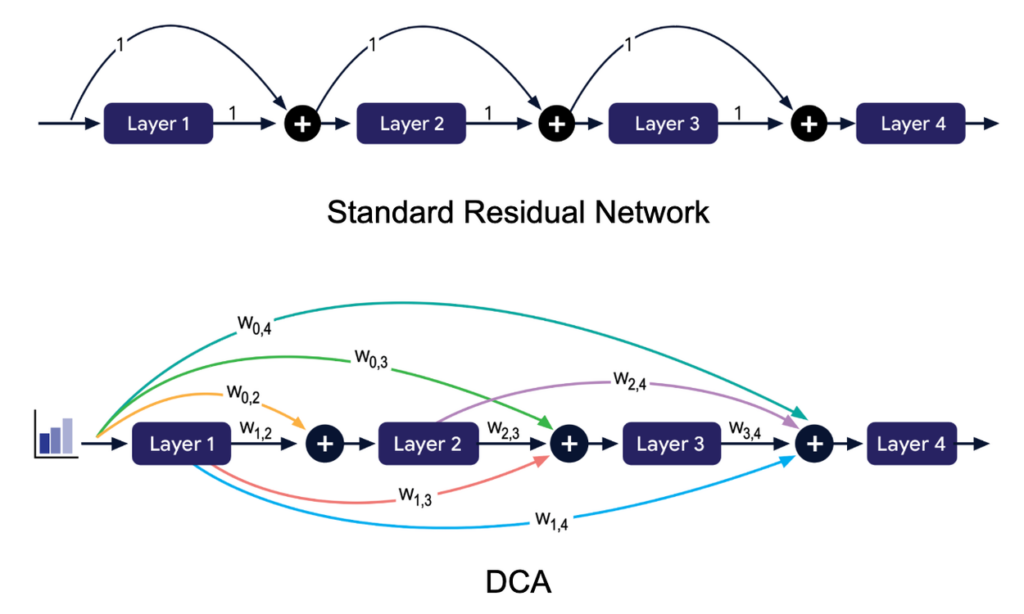
In a research blog published on November 23, 2026, Google researchers described DeepCrossAttention (DCA), a method introduced in their ICML 2025 paper for changing how transformers carry information between layers. Rather than relying only on standard residual connections, which add a layer’s input to its output, DCA lets each token draw selectively from representations produced by earlier layers.
DCA uses learned, input-dependent weights to route information across layers. The researchers argue that this can help preserve details from earlier layers that might otherwise be diluted as a model gets deeper.
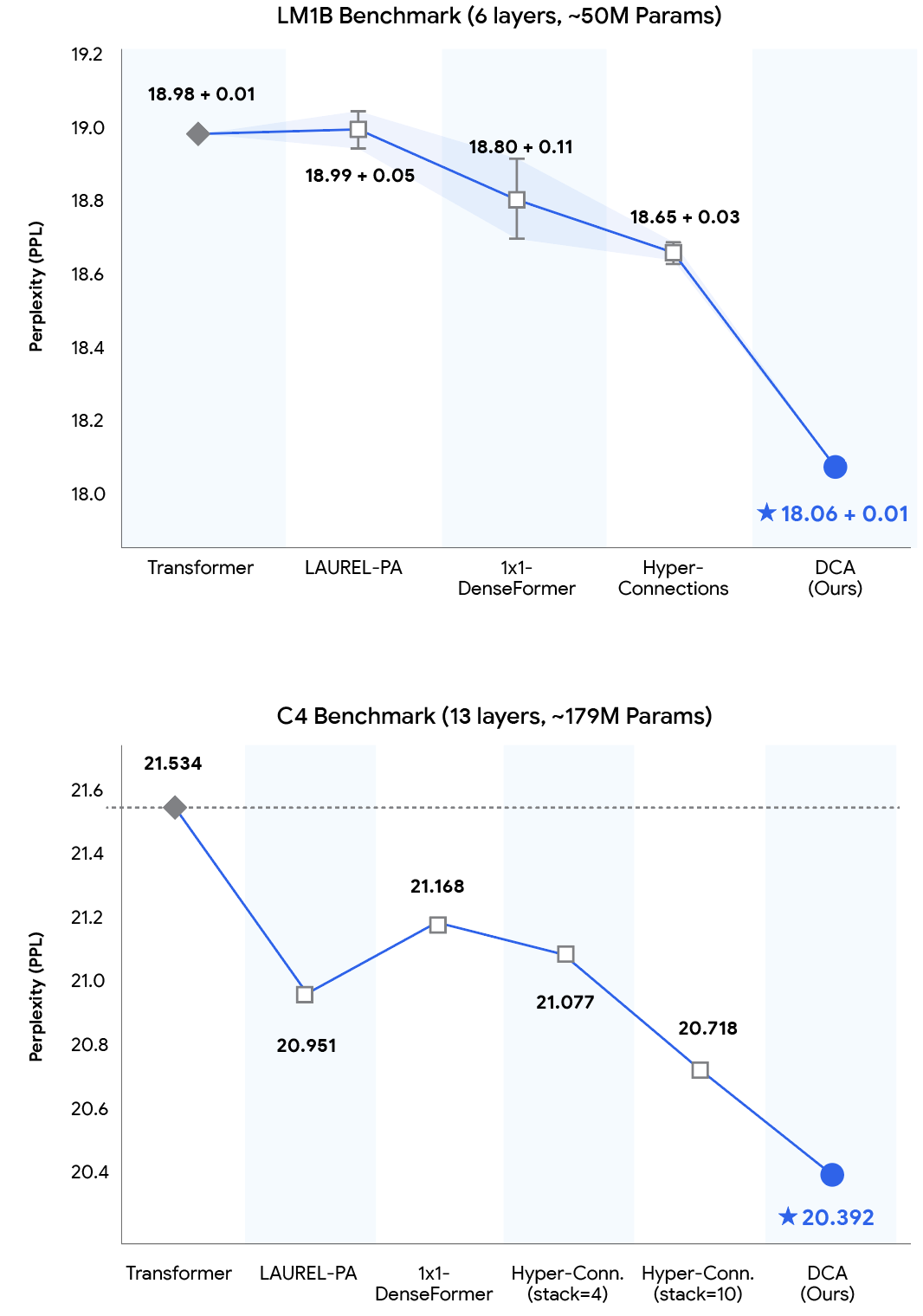
In the researchers’ language-modeling experiments on LM1B and C4, DCA achieved lower validation perplexity than the tested standard transformer and alternative connection designs under the same parameter and training budgets. They report that DCA matched standard-transformer performance in up to five times fewer training steps. On LM1B, a fixed-width standard transformer needed 42 layers to reach perplexity below 14; a 30-layer DCA model reached a lower perplexity, with 29% fewer layers and parameters in that comparison.
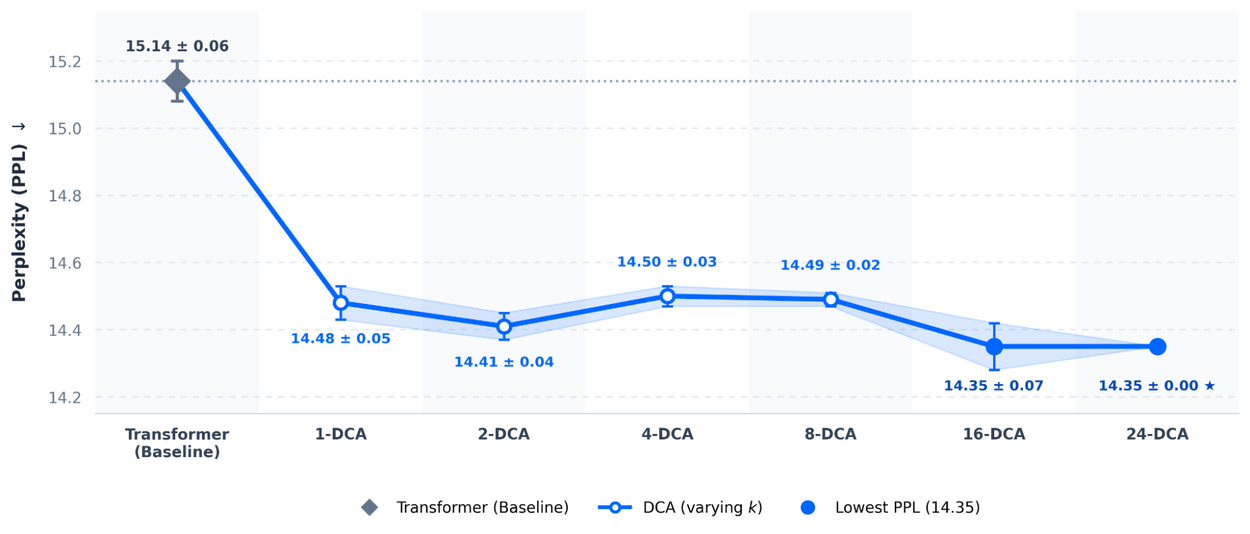
The researchers say DCA’s routing module added less than 0.2% to total model parameters, though accessing representations from multiple layers increased memory-bandwidth use. They also tested adding DCA to an already pretrained transformer: after further training on LM1B, perplexity fell by 0.19, compared with 0.02 from continuing standard training.
These are results from the reported experiments, not evidence that the same gains will hold for every transformer architecture or deployment.