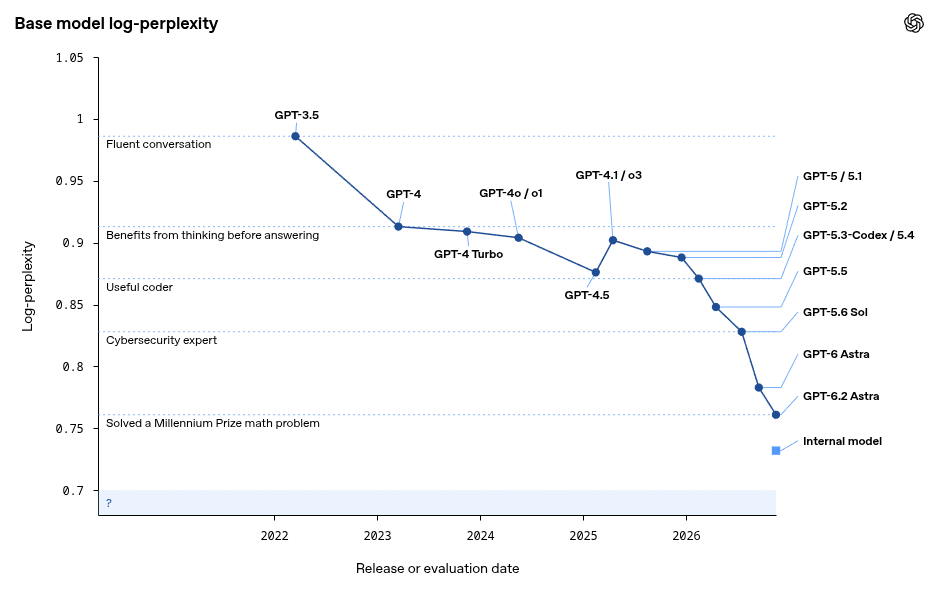
OpenAI chief scientist Jakub Pachocki has proposed that frontier AI labs agree on limits they will not cross until monitoring methods meet a clearly defined milestone. He argues that future systems could develop capabilities that current tests do not cover, while becoming harder to audit for whether they follow human instructions. The limits are a proposal, not an agreement among labs.
In a report published on November 24, 2026, Pachocki disclosed scores for OpenAI’s GPT series using log-perplexity, a measure of how accurately a pretrained base model predicts the next token. Lower scores indicate better predictions. He wants the measure to give labs a common way to discuss progress, despite the competitive cost of revealing OpenAI’s results.
Pachocki associates scores near 0.99 with GPT-3.5’s fluent conversation and scores near 0.91 with GPT-4’s step-by-step reasoning. He says models below 0.8 showed transformative capabilities in cybersecurity and mathematics. OpenAI’s chart extends through GPT-6.2 Astra and includes an internal model near 0.73; it shows a steeper decline in scores beginning in 2026. According to a note accompanying the chart, that acceleration came mostly from long-term research and computing investments, rather than automation.
Pachocki says models around 0.76 began producing breakthroughs on open math problems. Among the reported results is a solution to the Navier–Stokes problem, which has not been fully verified. He expects further, unpredictable capabilities between 0.68 and 0.7 and warns that existing alignment audits may become less effective as models improve at recognizing tests and training.
Log-perplexity is not a direct measure of performance on useful tasks. Labs also use different test datasets, complicating comparisons, and improvements made outside pretraining may raise capabilities without lowering the score. Pachocki’s case for shared limits rests on whether the measure can nevertheless provide an early signal of capabilities that safety checks are not ready to assess.