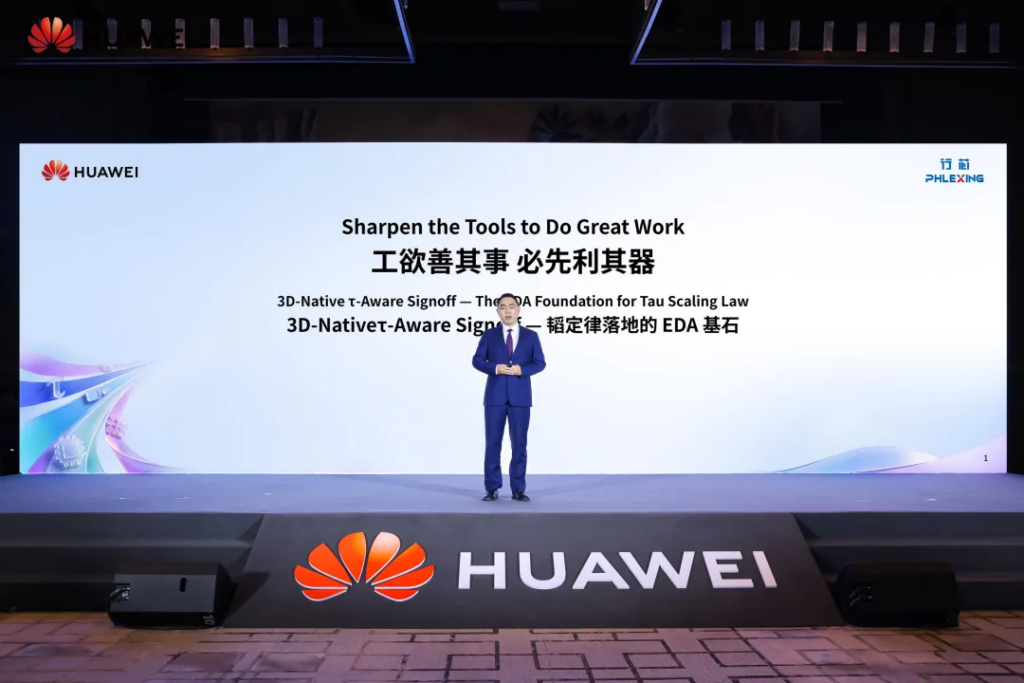
Huawei connected Xingxin Technology’s electronic design automation (EDA) software with tools from other Chinese developers in a working chip-design project, according to Xingxin chairman and general manager He Qing. Speaking at the seventh Huawei Innovation and Intellectual Property Forum in Beijing on November 24, 2026, He described it as the industry’s first successful integration of Chinese-developed EDA tools into a single design workflow. The project involved fabless chip designers, multiple fabrication plants and packaging companies.
He said the work grew out of a multiyear collaboration on Tao EDA, a set of design tools for Huawei’s Tao chips. Xingxin developed the underlying technology for what it calls 3D-Native τ-Aware Signoff, a way to verify three-dimensional chip designs. The aim, He said, is to let engineers measure and verify whether a design change reduces the time parameter τ.
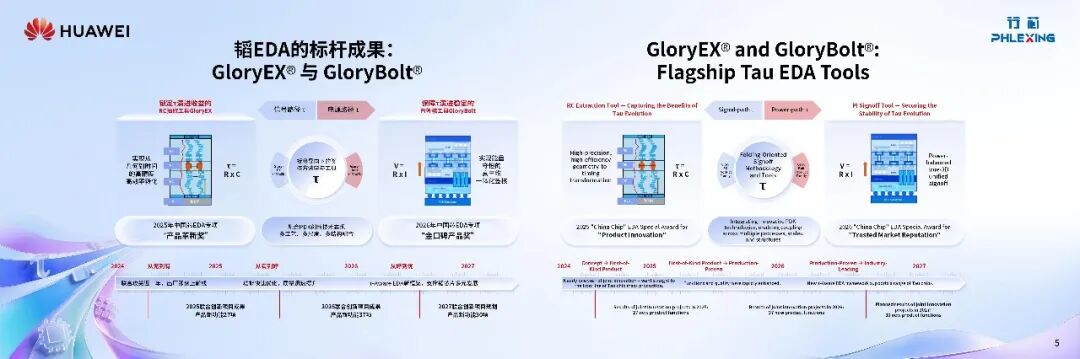
Two Xingxin tools handle different parts of that check. GloryEX extracts resistance and capacitance from the geometry of signal paths so engineers can assess the effect on timing. It won the product innovation award in the 2025 China Chip EDA category. GloryBolt checks power integrity across a three-dimensional design using a method that He said accounts for conservation of energy. It won the product reputation award in the same category in 2026.
Huawei and Xingxin also developed process design kit (PDK) technology to model interactions across different processes, scales and structures. According to He, their joint projects delivered 27 new product features in 2025 and 37 in 2026. The partners have planned 30 more for 2027, and Xingxin intends to work with industry partners on a broader τ-aware tool framework for Tao chips.