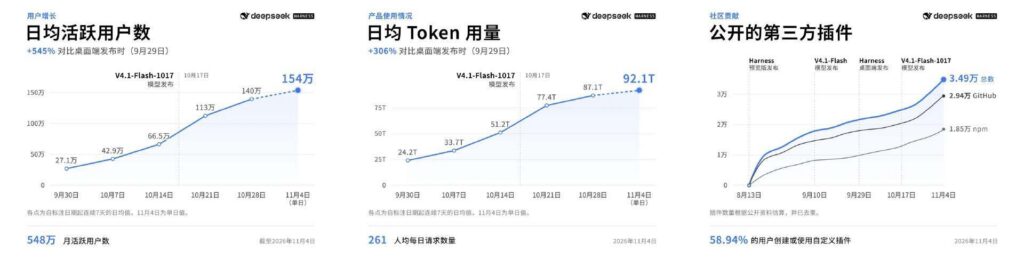
On the evening of November 5, DeepSeek Harness published its latest product and community update. As of November 4, among users of the official API, daily active users had reached 1.54 million and daily token consumption was about 92 trillion. Third-party plugins on the platform had grown to about 35,000, and about 60% of active users had created or installed at least one third-party plugin.
DeepSeek Harness says it wants to become an operating system for the agent era: stable base capabilities and general functions for users, with professional scenarios, specific industries, and personalization left to developers through plugins. Its “everything is a plugin” design even means built-in features can be replaced by third-party plugins.
From the v0.1 release on August 13 to this update, DeepSeek Harness has been expanding from an agent tool toward an open application platform. Community developers have already built many third-party plugins around content creation, design, context management, and research.
More plugins also raise new questions. Does a larger plugin set actually make an agent stronger? Can large amounts of plugin documentation and tool rules crowd the model’s context and raise execution cost? For ordinary users, is the better offer room to assemble their own setup, or a complete product that works out of the box?
Openness, and whether more plugins make an agent harder to use
The article describes the open plugin architecture as DeepSeek Harness’s main attraction. Users do not have to accept a vendor-defined agent workflow. They can combine models, tools, memory, and interface to build a workspace for their own needs.
One user said they had mainly used Hermes for general tasks and OMP for programming, and that neither tool fully met their customization needs. After moving to DeepSeek Harness, they added plugins for a kanban, themes, token optimization, memory, visual connectors, and a browser, and in less than a day assembled an agent environment that fit their work habits. What surprised them more was speed: DeepSeek Harness was faster at finding a bug that the same Qwen 3.8 model might previously have needed 24 hours to find.
Other users are trying to extend DeepSeek Harness from a single tool into a general agent workspace.
A developer released dsh-aio-agent, which connects coding agents including Cursor, Claude Code, Codex, OpenCode, CodeBuddy, and Kimi Code so users can choose among those tools in one interface. Another developer built dsh-ltm, a local long-term memory system that supports Chinese keyword search, memory recall scoped by project, and deduplication, editing, and management of memories.
A plugin named TheOne uses a large model to identify the topic of a user message and automatically routes it to a separate session, so multiple projects and topics are not mixed into one conversation. Another community project uses an ESP32-S3 board as a USB mouse and keyboard for an iPhone and receives the phone’s screen over AirPlay. The agent can take screenshots, click, long-press, swipe, and type, and can control a real iPhone that has not been jailbroken.
The article says the plugin ecosystem already includes many applications with practical use. It also says that extending capability through plugins can make an agent more complicated to use.
On November 5, a developer described moving from “everything through plugins” to actively removing them. They said they had once installed more than 15 plugins on the agent, and that as the number grew the system instead hit infinite loops, context overflow, and higher token consumption. In their view, each added plugin requires the model to understand additional instructions, usage rules, and constraints. If information from many plugins enters the context at once, the model has to spend more attention on the tools themselves rather than on reasoning about the task. They also argued that more plugins do not necessarily give the agent more freedom: too many preset tools and rules may limit the room the model has to solve problems on its own.
Another user said that staying lean is acceptable when it does not affect core capability or cause regressions, but that developers first have to take responsibility for their own plugin mix. If they want to save tokens, that user said, they simply would not install plugins meant to liven the atmosphere. They called the complaints a transfer of personal responsibility: you cannot blame the property seller for offering an unfinished shell rather than a fully finished home just because you did not complete the interior.
A further user said DeepSeek Harness prompts are larger than Pi’s, and suggested borrowing Pi’s selective disclosure so the model is given a plugin’s instructions only when needed, rather than keeping every plugin’s information in context all the time.
Similar concerns show up in execution cost. One user said that finishing a small project with DeepSeek Harness consumed more than 20 times the tokens used by OpenCode, and that a single task took 30 to 40 minutes compared with about 30 seconds in OpenCode. The article treats this as one person’s experience, while noting that it at least shows users paying attention to the cost of calling tools.
Frequent releases, with plugin governance still unfinished
Facing plugin management, context cost, and the barrier to use, DeepSeek Harness has shipped several rounds of updates over the past few months. A review of official GitHub releases shows the focus moving from plugin extension interfaces toward discovery, installation, updates, dependency management, and runtime monitoring.
From October 15 to October 23, DeepSeek Harness updated plugin management in succession. It added support for a custom plugin index and version-compatibility checks, then plugin enable and disable, uninstall, dependency sync, and hot reload, and an entry for the agent to help create plugins. Starting with v0.2.1-rc.1, long conversations can be compressed automatically in minimal mode, and the web and desktop clients can also compress context manually with the /compact command.
v0.2.2-alpha.2, released on October 28, began supporting updates to third-party plugin packages and attempts to restore the old version if a hot update fails. It also added an experimental developer statistics plugin that can show context, cache, and time spent in the model and in tools. v0.2.2-alpha.3, released on November 3, added diagnostics for failed plugin installs and a Host log entry, and distinguishes an installation failure from a failure to enable a plugin after it is installed.
v0.2.2-rc.1, released on November 4 as the first release candidate of the 0.2.2 series, gathers improvements from earlier versions in that line. It also improves reuse of cached conversation history for Auto automatic review between consecutive tool calls, compresses history with the original model before switching to a model with a smaller context window, and sets separate byte budgets for global and project-level AGENTS.md files so those instructions compete less with each other.
The article reads these updates as a partial response to community complaints. Plugin discovery and management are more complete, dependency sync and hot reload lower maintenance cost, long-conversation compression and cache reuse begin to address context and token use, and the statistics tool lets developers observe what an agent run actually costs.
Some feedback still points to instability in plugin updates and configuration recovery.
On November 5, a Windows user reported that after upgrading the desktop client from v0.2.1-rc.5 to v0.2.2-rc.1, 32 previously configured third-party and local plugin-package entries were lost. The number of plugins in the configuration file fell from 34 items to 2. Because a localization plugin was incompatible with the new version, the app also failed on first launch. There was no automatic configuration backup before the update, and the client did not support rolling back a version, so the user had to restore the working environment manually. The article says the whole repair took about five hours.
For people who use an agent over a long period, a plugin is not only a small tool that can be swapped at any time. A user may already have built a workflow around particular plugins and configured MCP servers, model routing, agent presets, and local dependencies. If an upgrade overwrites that configuration, what is lost is not one plugin but the working environment accumulated around it.
The article says the plugin ecosystem still needs reliable version management, dependency checks, configuration protection, automatic backup, and failure rollback. As agents take on more complex work, it says, users will expect that environment to be more stable.
Developer support and an official plugin marketplace
The developer support plan announced with this update is aimed at continued ecosystem building.
DeepSeek Harness says it will further improve the stability and compatibility of the plugin API, strengthen plugin security mechanisms, and build an official plugin marketplace so developers can upload plugins more easily and users can more easily find and install the functions they need.
On incentives, it is preparing a support program specifically for plugin authors. Early considerations include token incentives, technical exchange, and featuring work, to support developers exploring new ideas and continuing to improve existing plugins.
The article notes the limits of those measures. Token incentives can lower the cost of exploration and testing, but they do not directly guarantee plugin quality. Featuring work can increase exposure, but it does not mean a plugin will be maintained over time. For the platform, the article says, the question that decides whether the ecosystem can last is how developers earn ongoing returns, how users find plugins that are actually reliable, and how different plugins work together stably in the same agent environment.
DeepSeek Harness has an early scale of users and developers. The next stage, the article says, is infrastructure that keeps plugins running, compatible with one another, and easy to use. Beyond a distribution channel, an official marketplace would also need to consider review, quality ratings, version compatibility, permission management, and security notices. Otherwise, a larger plugin count can also mean a heavier burden of filtering and maintenance for users.
Original article: InfoQ
References cited by the original article:
- https://mp.weixin.qq.com/s/xqyrRaiBpIcf0jeJzP7W0g
- https://github.com/deepseek-ai/deepseek-harness/discussions/categories/show-your-plugins
- https://github.com/deepseek-ai/deepseek-harness/discussions/12329
- https://github.com/deepseek-ai/deepseek-harness/discussions/7374
- https://github.com/deepseek-ai/deepseek-harness/discussions/12349
- https://www.reddit.com/r/DeepSeek/comments/1wqb9se/deepseek_harness_feedback