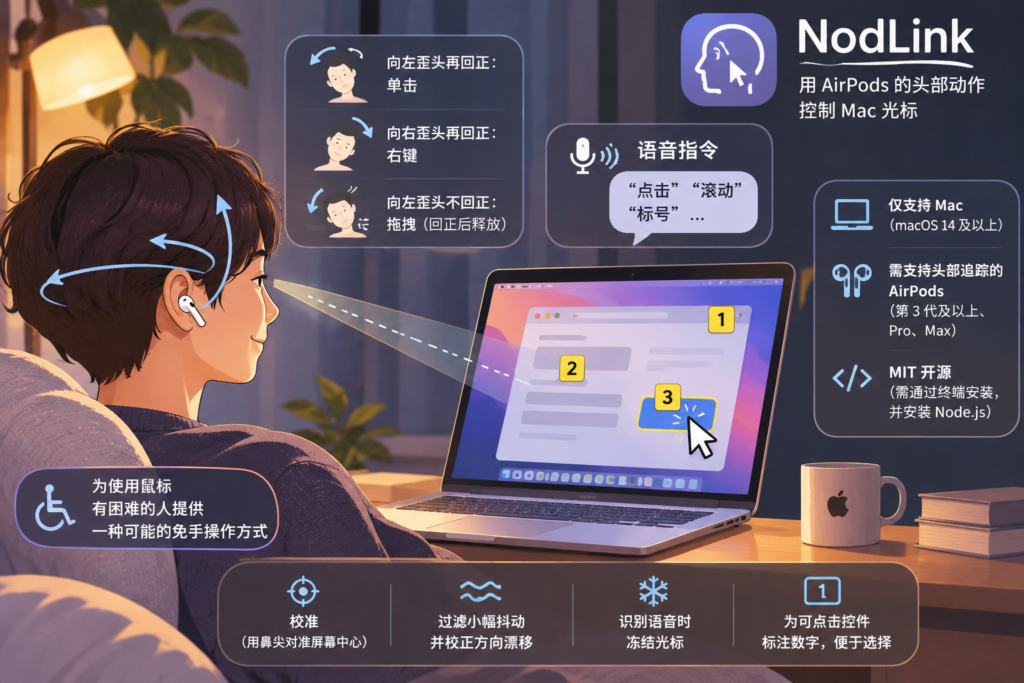
In an article dated November 8, 2026, developer Uinui described NodLink, an open-source tool that turns head movements detected by AirPods into Mac cursor movements. Uinui presents it as a potential hands-free option for people who find using a mouse difficult, rather than as a tested replacement for other assistive devices.
After calibration, turning your head moves the cursor across the screen. By default, tilting left and returning upright produces a click; tilting right and returning produces a right-click. Holding a left tilt allows dragging until you straighten your head. The actions can be remapped, including to hold the Fn key for voice input. NodLink also accepts spoken commands for actions such as clicking and scrolling. Uinui says speech recognition and the data used by the tool are processed locally.
To make small targets easier to select, NodLink can label nearby clickable controls with numbers. It freezes the cursor while recognizing a spoken command, so a slight head movement does not change the target before the action runs. Uinui notes that voice recognition sometimes mishears commands.
NodLink reads AirPods motion data through Apple’s CMHeadphoneMotionManager. According to Uinui, it requires a Mac running macOS 14 or later and head-tracking-capable AirPods: third-generation or later standard AirPods, AirPods Pro, or AirPods Max. A Swift program on the Mac reads the sensor data, handles voice commands and controls the pointer; a web console built with Node.js and three.js handles calibration and other controls. The project is available under the MIT license, but installation currently requires using the terminal and installing Node.js.
The tool tracks head direction, not eye movement. Uinui says users calibrate it by pointing their nose at the centre of the screen; an optional, longer calibration follows points around the display. The software filters small involuntary movements and corrects gradual directional drift. Uinui demonstrated tasks including closing a pop-up, replying to a message and navigating short videos, but these are the developer’s demonstrations, not independent accessibility testing.
NodLink currently supports Mac only. Uinui also outlined a possible iPhone approach involving an ESP32 board acting as a Bluetooth mouse, but described it as a future plan, not an available feature.