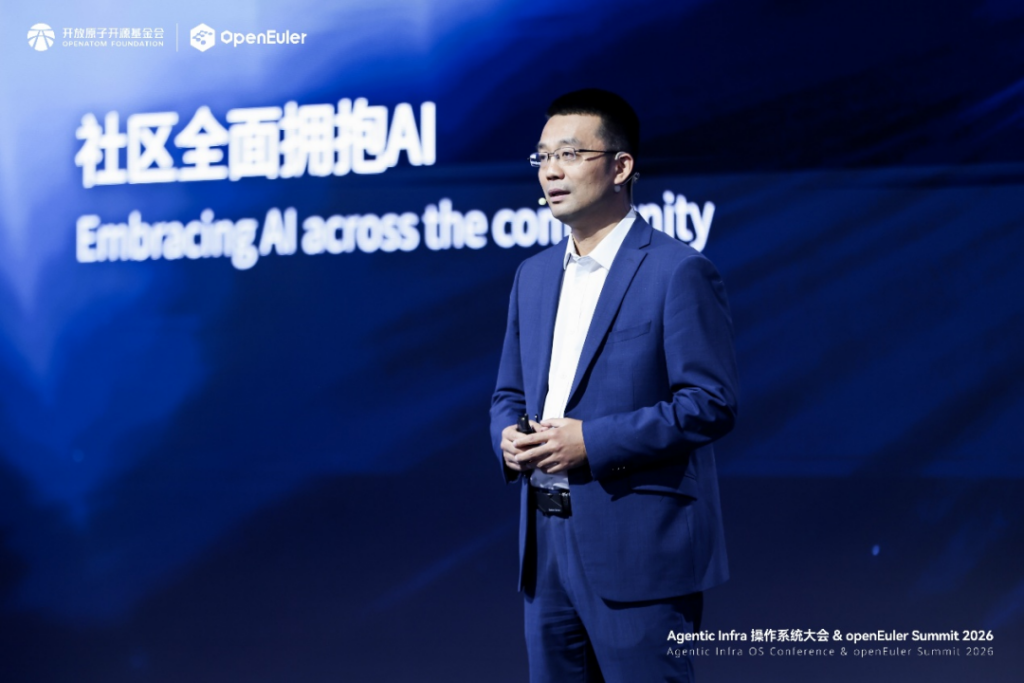
In reporting published on November 17, 2026, openEuler described a new focus on the infrastructure needed to run AI agents. At a November 13 event in Beijing, the project unveiled an operating system positioned for “Agentic Infra” and released openEuler 24.03 LTS SP5, with work spanning sandboxes, KV Cache, memory systems and agent security.
OpenAtom openEuler committee chair Xiong Wei said the rise of agents does not require replacing the operating system from the ground up. In his view, the operating system’s established responsibilities—including resource management, scheduling and isolation—remain, but must adapt to how agents execute tasks. He identified two priorities for openEuler: making model inference more efficient and less costly, and helping agents execute tasks efficiently and securely.
Xiong pointed to sandboxes as an example. An agent may rapidly call tools and launch multiple short-lived execution units during a single task. He argued that conventional virtual machines can impose too much startup and management overhead for that pattern, while an agent sandbox should retain necessary isolation in a lighter-weight environment. The relevant measures for users of such infrastructure would include startup latency, resource use, throughput and isolation under concurrent workloads.
The project is also continuing its work on supernodes, which coordinate resources across nodes. Xiong said compatibility with existing software interfaces matters, but running an application on supernode hardware does not by itself mean the application uses that hardware effectively. He described new interfaces and applications built specifically for supernodes as a direction openEuler is exploring. According to Xiong, joint work with JD.com applied supernode hardware, its operating system and KV Cache technology to internet workloads at scale during the 2026 Singles’ Day period, reducing latency for the relevant business workload by about 15%.
The event also included the launch of HECOS 1.0 by Pakistan’s Higher Education Commission, described as the first locally developed overseas operating system based on openEuler. Separately, openEuler announced technical exchanges with Ubuntu concerning supernodes and other areas.
The project’s scale and future goals should be read with their stated qualifications: cumulative domestic installations of openEuler-based operating systems were expected to exceed 22 million, while Frost & Sullivan forecast a 61% share of China’s new server operating-system market in 2026. OpenEuler also set a goal for AI to assist with handling 80% of CVEs by the end of 2026; that figure was a target, not a reported result.