
ITHome’s November 11, 2026 report covers 2026 Android Dev Summit announcements attributed to Matthew McCullough, vice president of product management on the Android developer team. The summit introduced tools and APIs for writing code with agents, building agent experiences, and adapting apps across screen sizes.
Original article: ITHome. Event page: Android Dev Summit. A keynote recording is linked on Bilibili.
Choosing models and agents
The post says developers want to choose models and agents that fit their work as more of both appear. Updates to Android Studio and the Android CLI are presented as that choice. A related write-up is developer tools and performance.
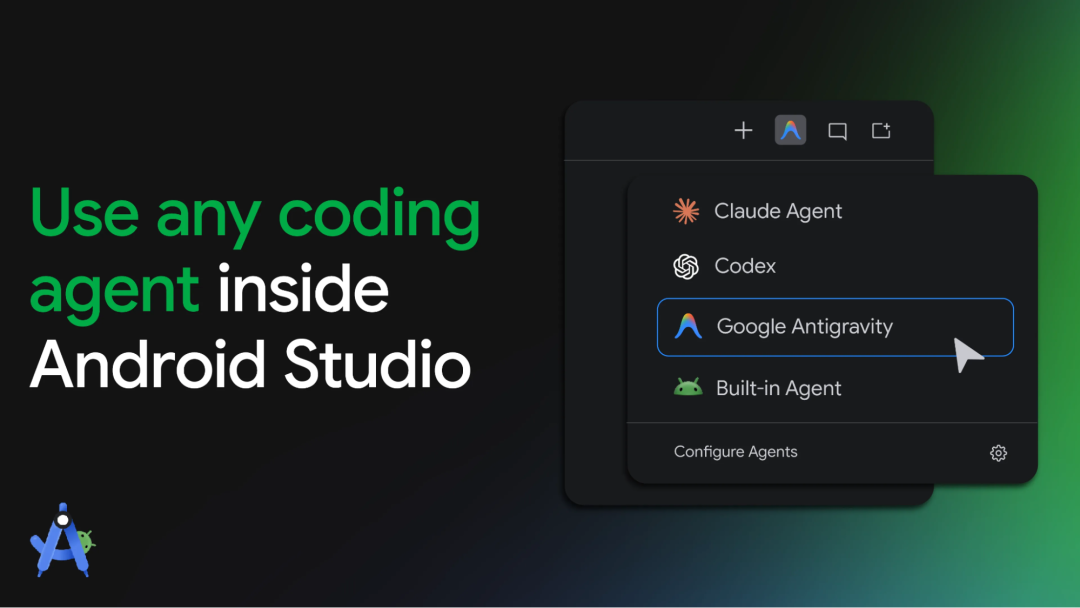
Android Studio Rabbit 2 is stable. Inside Android Studio, developers can select a coding agent such as Claude Agent, Codex, Antigravity, or more than 40 other ACP-compliant agents, while still using the IDE’s developer tools. Details: AI agents in Android Studio.
Android CLI changes described in the post:
- Device streaming and Compose preview. Firebase-backed Android device streaming can connect remotely to real devices for testing from the Android CLI. Agents can render Jetpack Compose previews for visual checks without an Android emulator or an APK deploy. Device streaming, preview.
- Profiling. Perfetto system traces can be captured to debug cold-start latency, UI jank, and background wakeups, and to examine performance and memory. Profiler.
- Analysis. App bundles and libraries (AAR or JAR) can be inspected for quality signals such as obfuscation, optimization, and shrinking scores, using the same validation logic as Google Play before upload. Analyze.
- Android Skills. More than 30 skills across more than 20 areas, including permission security, Glance widget layout, and Compose performance. Android Skills.
- Official agent plugins. The Android plugin for Google Antigravity now includes the latest Android CLI features, plus deeper integration so Compose previews and real Android devices can be used inside Antigravity. Official plugins were also released for Claude Code and OpenAI Codex. Agent plugins.
Agent experiences on Android
New APIs are described as simplifying richer agent experiences. An Android intelligence system across the device ecosystem is said to offer both prompted and proactive help. When Gemini is the system-level AI agent, developers can prototype a Connected App to share app services with Android users, then register for the Connected Apps Platform preview to ship across device platforms.
With Android MCP, app capabilities can be called by any agent. The AppFunctions API, called Android’s unified tool-calling layer, exposes functions to an app’s own on-device agent or to a system-level agent. AppFunctions is in beta. AppFunctions.
A2UI for Jetpack Compose is in alpha. Agent-to-UI is described as letting an agent answer with the app’s own components as an interactive interface instead of a long text reply. A native Jetpack Compose renderer is intended to place those surfaces inside the app.
An Agentic API in ML Kit, also alpha, targets on-device agents based on Gemini Nano 4. It extends the ML Kit Prompt API and is said to support automatic function execution, saved conversation history, orchestration loops, and built-in automatic safety checks. ML Kit generative AI.

Connected Apps Platform
The Connected Apps Platform is presented as a way to reach high-intent users in Gemini and Google Search. Developers can build natively with Android MCP or a remote MCP, prototype in Gemini developer mode, and register through the Google Connected Console preview program when ready to release. Connected Apps.
APIs across device shapes
The post says further APIs are meant to simplify adaptation and support differentiated experiences on a wider set of Android devices, using a Jetpack Compose-first base, adaptive building blocks, and agent UI features.
- AppState (alpha) brings Compose’s reactive model to the state layer so developers and AI agents can keep state when the device configuration changes.
- Navigation 3 version 1.2 is stable, with deep links and richer predictive-back handling. Deep links.
- Compose 1.13, described as nearing stable, adds built-in adaptive layout support—Grid and Flexbox have moved to stable—plus Progressive Blur and Formatted Text.
Googlebook, foldables, and an adaptive skill
With Googlebook, the post says, apps can adapt to phones and laptops without a separate codebase. A Compose adaptive skill can help agents adapt mobile apps for phones, foldables, Googlebook, tablets, large in-car screens while parked, and XR devices. Compose adaptive skill.
An update to that skill is described as speeding desktop adaptation. It reviews Compose UI and can find and implement keyboard shortcuts, custom pointer cursors, hover states, and tooltips on buttons and controls. Beyond parsing Navigation and moving layouts to Grid, FlexBox, and mediaQuery, it can handle end-to-end state management for the whole app. It also supports foldable posture optimization, including automatically refactoring media and camera interfaces into desktop-mode layouts.
Next year, the report says, Google Play will focus on how apps and games run on foldables and will offer more ways to show adaptive-design work. For apps, it points to the Compose adaptive skill and the Android adaptive app quality guidelines. For games, it points to the adaptive games guidance. Specific Google Play Store requirements are to be announced later this year. Those time references are as stated in the November 11, 2026 report.
Android XR
Google and XREAL jointly introduced XREAL AURA, which the announcement calls the world’s first wired XR glasses powered by Android XR. XREAL AURA.
Several libraries and tools are now stable, according to the post:
- Jetpack XR SDK core libraries provide production APIs for Jetpack SceneCore, ARCore for Jetpack XR, and XR Runtime, with long-term API stability and backward compatibility.
- The Android XR emulator in Android Studio is for building, iterating, and checking visuals for XR glasses, audio glasses, and display glasses without physical hardware.
- Android XR Engine Hub offers workflows to start and analyze performance traces in Unity, Godot, and Unreal.
- The ARCore Geospatial API for the Jetpack XR SDK and for Unity is described as anchoring digital content to the real world on wired XR glasses and smart glasses with high-precision positioning and local tracking.