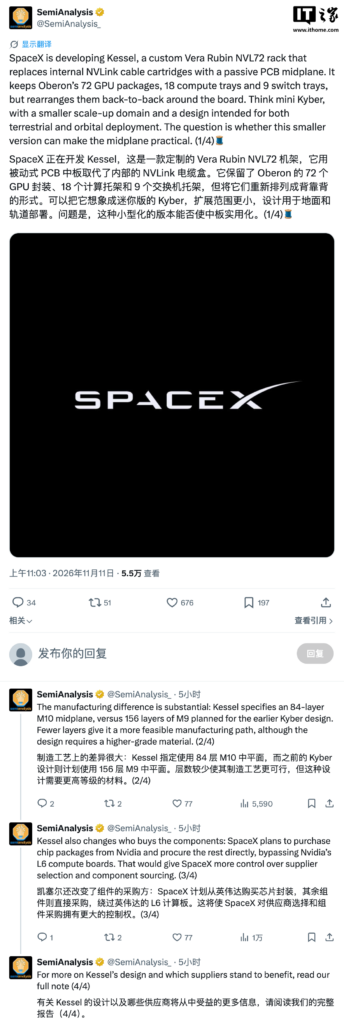
IT Home reported on November 11, 2026, that semiconductor research firm SemiAnalysis posted on X that morning that SpaceX is developing a custom AI server rack called Kessel. The design would keep Nvidia chips while SpaceX procures more of the supporting hardware itself. Kessel is intended for both ground data centers and orbital computing.
SpaceX would still use Nvidia chips but would choose more of the accompanying hardware. According to the report, the company plans to buy chip packages directly from Nvidia and source the remaining components on its own, rather than through Nvidia’s L6 compute boards. That would let SpaceX select suppliers and parts more independently.
Kessel would also change the rack’s internal layout. Nvidia’s standard Vera Rubin NVL72 rack connects compute equipment and switches with internal copper-cable modules. Kessel would remove those modules and use a passive circuit board in the center of the rack as a connecting midplane.
The design would still follow the Oberon approach, with 72 GPU packages, 18 compute trays, and 9 switch trays, but the trays would be mounted back-to-back on both sides of the central board. SemiAnalysis compared the overall design with Nvidia’s Kyber approach, which also uses a circuit-board midplane, while noting that Kessel is smaller.
In March 2026, SemiAnalysis described a Kyber configuration with 144 GPUs, twice the GPU count of Kessel. In the November post, the firm called Kessel a “mini Kyber,” with a smaller scale-up domain that could be deployed on the ground or in orbit.
A smaller scale could lower manufacturing difficulty while demanding higher-grade materials, IT Home reported. Kessel’s midplane would use M10 material and 84 circuit layers. The earlier Kyber plan called for M9 material and 156 layers. SemiAnalysis said fewer layers favor manufacturing, but the board must use a higher-grade material.
Whether these changes alone would solve the manufacturing problem remains uncertain. SemiAnalysis said the key question is whether the midplane approach can actually be put into practical use after the design is scaled down.
The work comes as SpaceX expands its AI data-center plans. SemiAnalysis said the previous week that SpaceX had raised its 2027 compute-capacity target to about 13 GW, and that 3.6 GW of projects across multiple sites were under construction. Analysts said: “We believe this target is achievable, and we have found more than 9 GW of capacity.”
SemiAnalysis also referred to expansion around Colossus and to SpaceX plans to build data centers in parts of the rocket park at the Starship base. Power supply remains a major difficulty. The firm had previously found that the electricity supply then available was not enough for these data centers.
Original article: IT Home