At the AI agent company Manus, engineer interviews no longer include traditional programming tests. Since March 2026, candidates have four hours to use Manus on a real problem. Interviewers then review the full process to assess how candidates work with AI, rather than testing independent coding alone. Candidates must also explain their approach.
Manus co-founder and chief product officer Tao Zhang said role boundaries inside the company are blurring even though public job listings still use titles such as frontend and backend engineer. He described those titles as an external convention because “the outside world hasn’t caught up yet.” In the product and marketing team he leads, product managers commit code and designers also write code. Work that once moved between product, design, and engineering can now be handled by one person using AI tools.
Zhang’s stated hiring judgment is that “AI is already very good at completing tasks, so we no longer need more people who are only good at completing tasks.” Manus places more weight on people who can determine what needs to be solved, coordinate resources, and drive an outcome than on job titles or task execution alone.
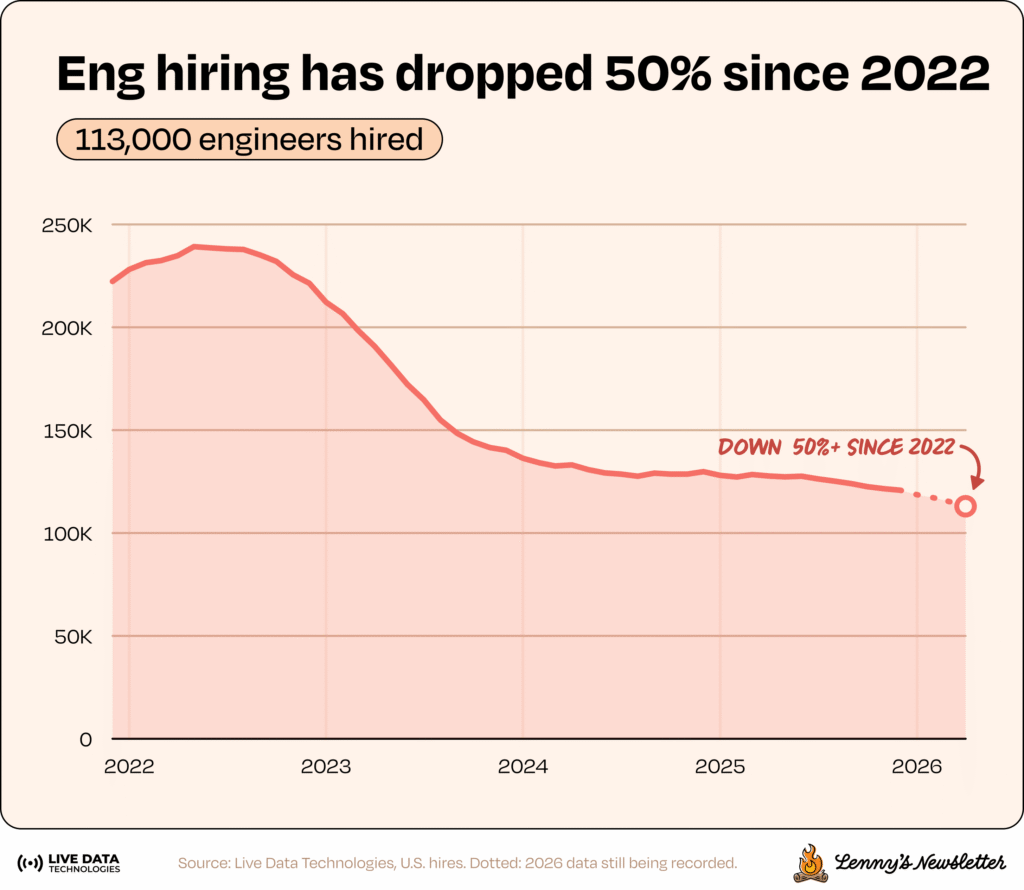
A separate employment report offers a wider view of whether that pattern extends beyond one company. On November 10, Lenny Rachitsky, formerly responsible for product and growth at Airbnb and author of Lenny’s Newsletter, published State of the Tech Job Market: Late 2026, his fifth report in the series. It draws on TrueUp, which tracks openings at more than 9,000 technology companies worldwide, and Live Data Technologies, which tracks hiring, departures, and promotions for about 124 million professionals.
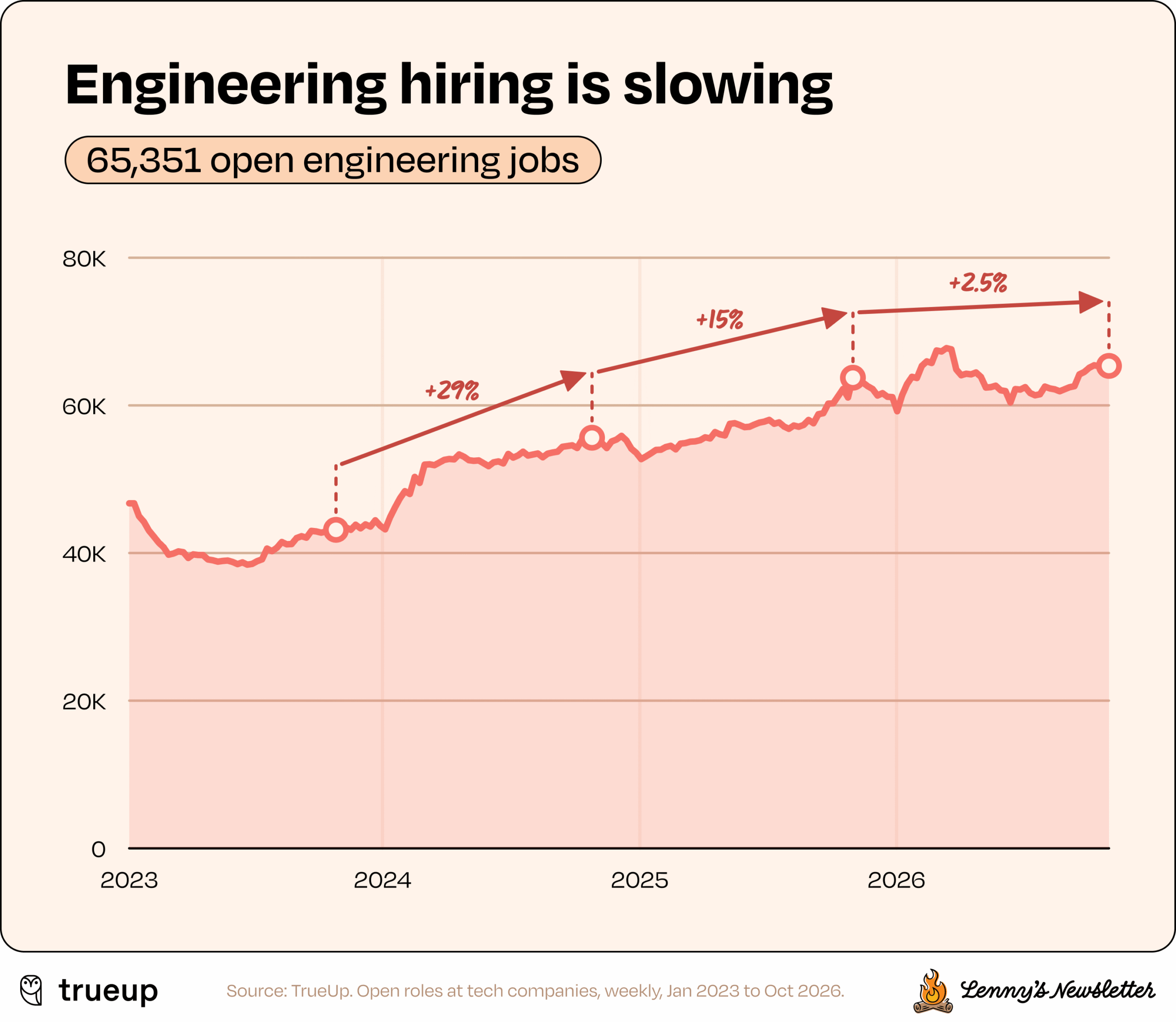
Live Data Technologies figures show U.S. companies hired about 113,000 software engineers from May 2025 through April 2026, compared with 239,000 in 2022. That is a decline of about 53 percent, to less than half the 2022 peak, with hiring falling each year since 2022. TrueUp data show engineering openings rose 29 percent in 2024 and 15 percent in 2025, then only 2.5 percent over the past year—the first near-stall in the series. More than 65,000 engineering openings remain at the companies TrueUp tracks, so engineering is still the largest category, but the scale is smaller than a few years ago.
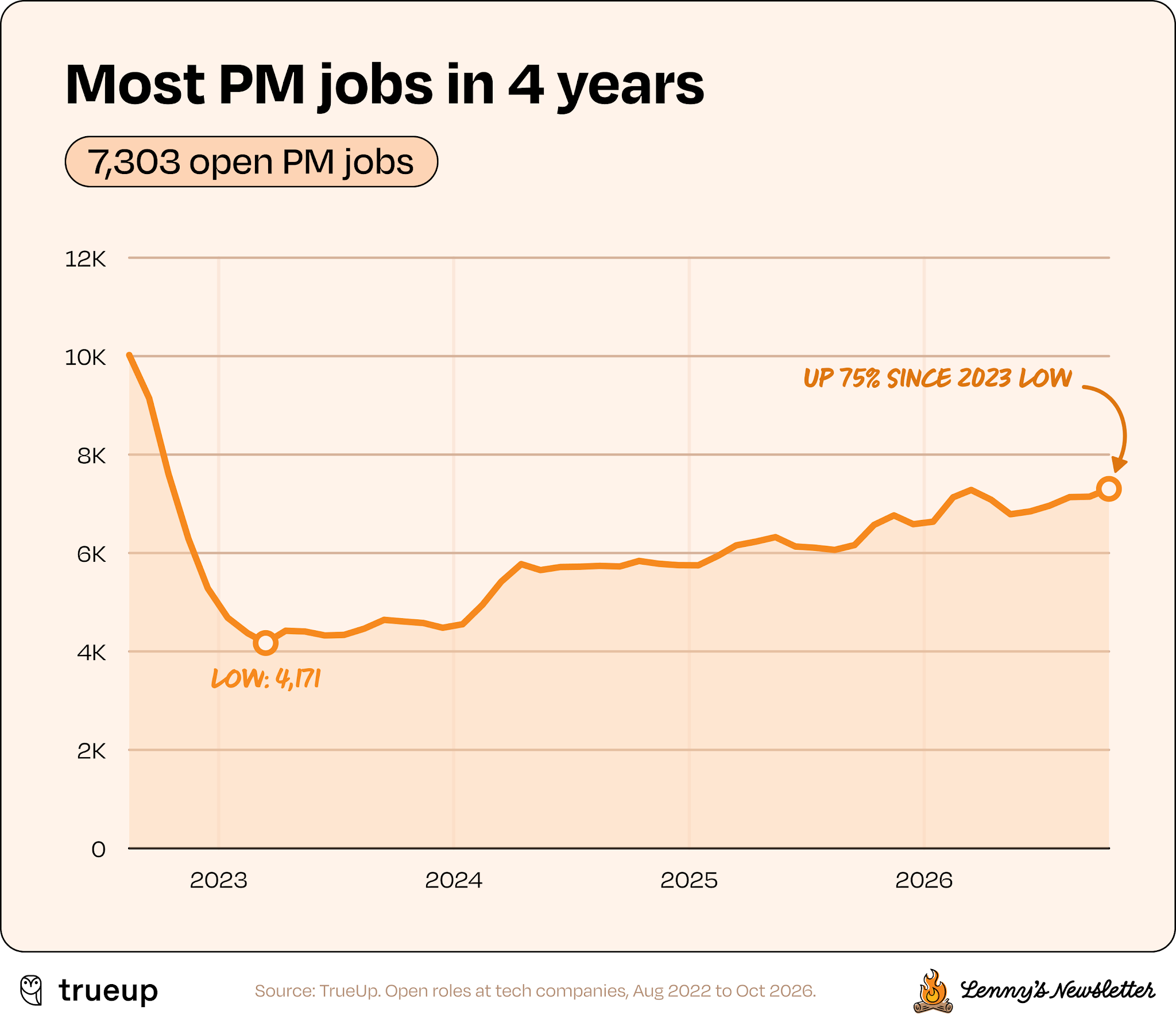
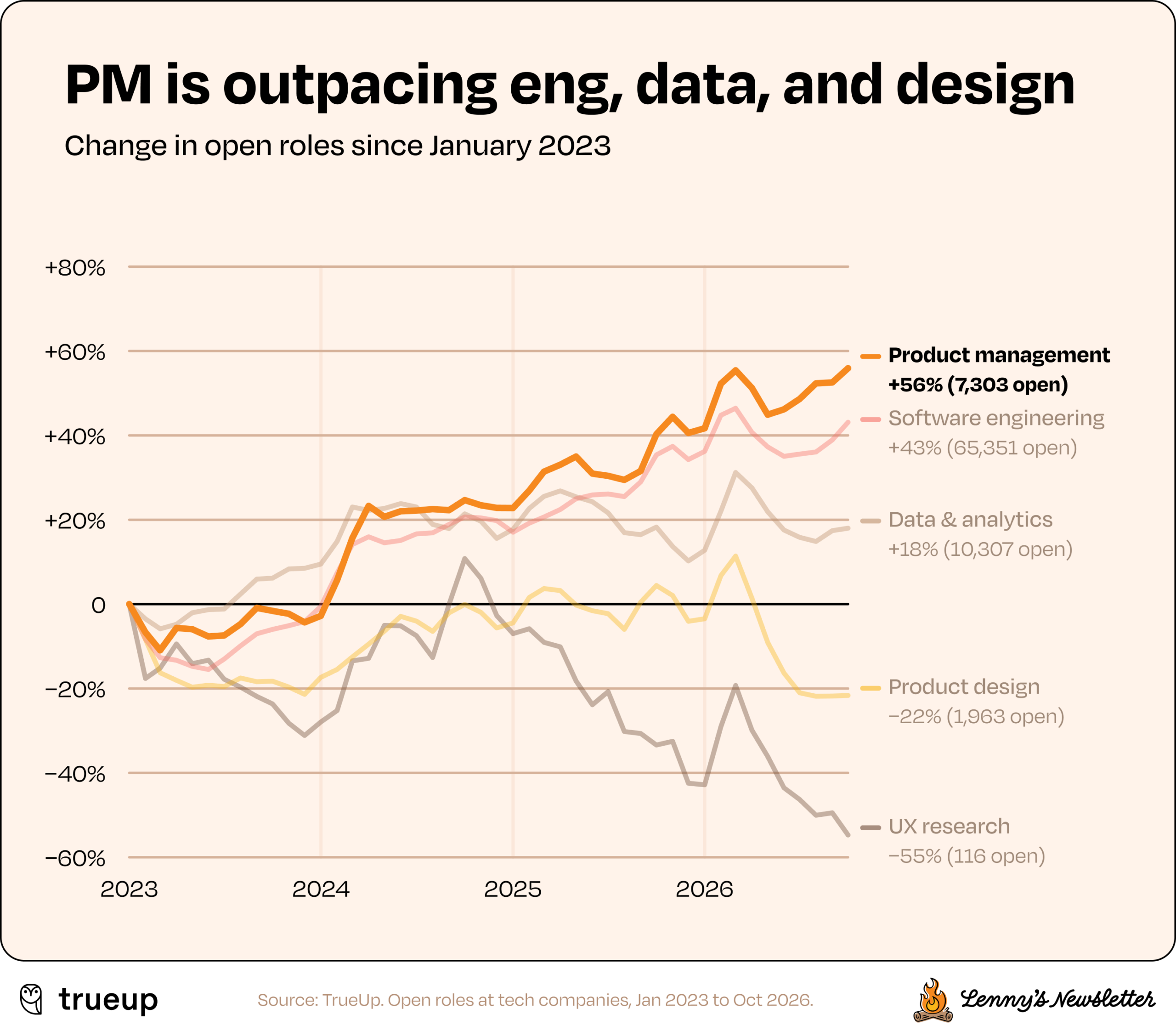
Product manager demand has moved differently. Since early 2023, global product manager openings are up 56 percent cumulatively, versus 43 percent for engineering roles over the same period. Openings are up 75 percent from the March 2023 low and are at their highest level in nearly four years. Among five core roles in the report, product management is the only one whose share of actual hiring rose, from 16 percent in 2021 to 21 percent now.
Design openings have contracted. TrueUp counts about 1,900 product design openings globally, down 28 percent year over year and a low since tracking began. In early 2023 there were about 1.9 product manager openings for each product design opening; the ratio is now 3.8 to 1.
Posted openings and completed hires do not move together. Since January 2024, engineering openings are up about 44 percent while actual U.S. engineering hires are down about 17 percent. Product manager openings have kept rising, but actual hires have been roughly flat or lower, though stronger than other core roles. Rachitsky’s reading is that companies may still want strong engineers and product managers while finding people who meet the bar has become harder.
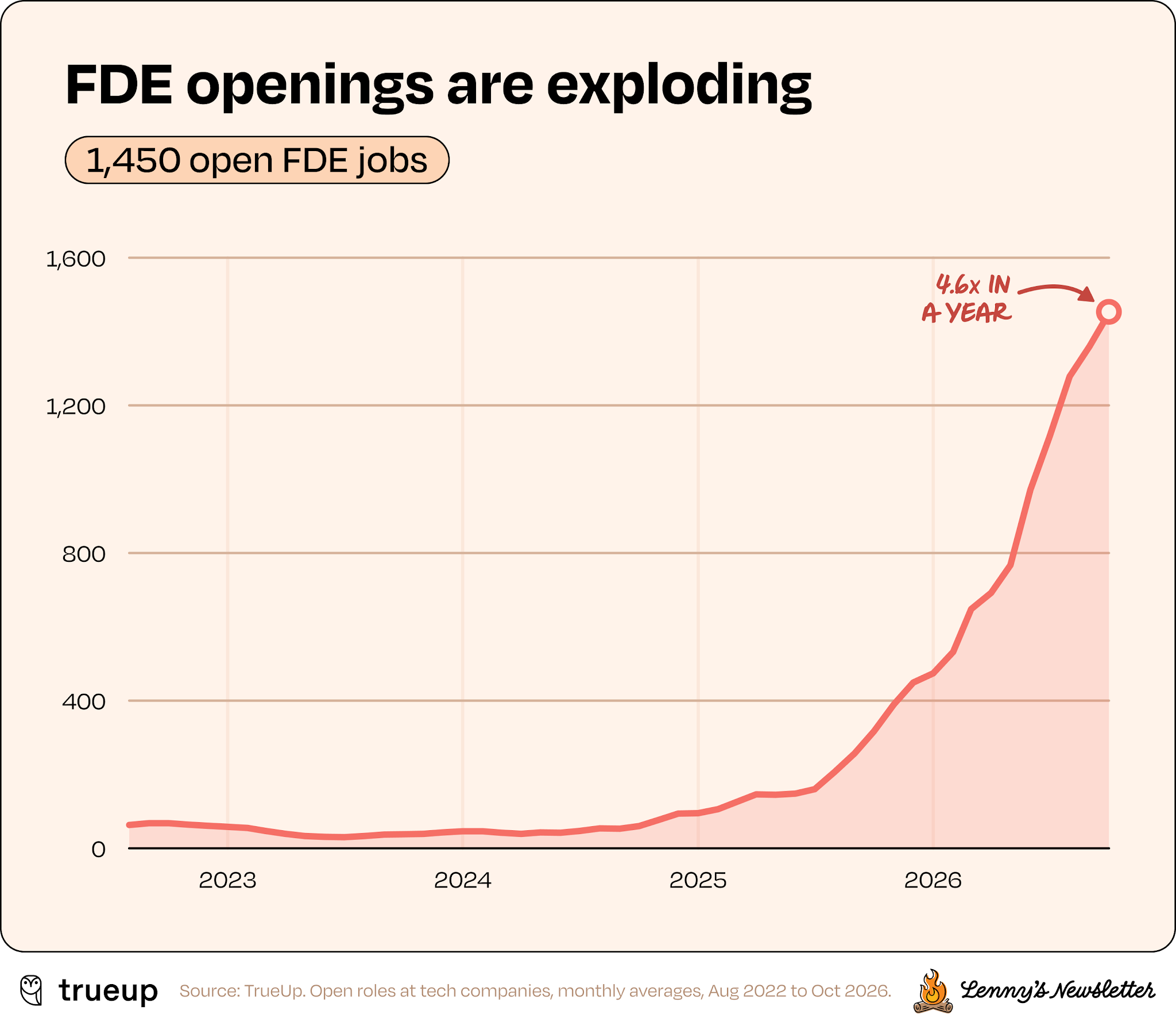
Within engineering, demand is uneven. Forward deployed engineer (FDE) openings—roles associated early with Palantir that embed engineers in customer operations, connect systems and data, and handle deployment—grew 4.6 times over the past year to about 1,500, from a base that was often only dozens of public openings. Rachitsky notes that some of the increase may be retitling, such as sales engineer roles renamed FDE, rather than net new jobs. From January 1 to November 6, 2026, Palantir hired at least 151 FDEs from other employers; Google hired at least 122. Accenture and Salesforce are also hiring the role. Over the same year, frontend and mobile development openings both nearly halved. Security engineering is among the fastest-growing engineering specialties in the report, behind only FDE.
Job-description language has shifted as well. Two years ago, the skills appearing most often in product manager postings were SQL, Jira, AWS, and Python. Large language models are now the most frequent keyword; Claude ranks third, and Cursor, OpenAI, and the Model Context Protocol are in the top eight, with AI model and application evaluation (evals) in the top ten. For engineers, Python remains the most mentioned skill and demand is still rising, while LLM mentions have passed Java, which declined over the past year. Kubernetes and similar infrastructure skills remain in high demand. For designers, Figma is still the most mentioned skill, but Claude passed CSS this spring to become the second most common keyword, and Cursor also appears more often than CSS.
A Gartner forecast published November 10 says that by 2030 more than 20 percent of workers worldwide may need to change what they do and how they work. The same forecast expects nearly 70 percent of technology-industry practitioners to face a relatively high degree of AI impact. Analyst Helen Poitevin said organizations further along in applying AI are already redesigning operations and the split of work between people and technology. The InfoQ account of Manus’s process and of the skill shifts in Rachitsky’s report describes employers looking not only at competence in one specialty, but also at whether someone can use AI on work that previously crossed several roles.
Original article: https://www.infoq.cn/article/HKFSZ6a0DM97BV7FXP2t
Referenced sources in that article: Web Summit interview, Lenny’s Newsletter report, Gartner.