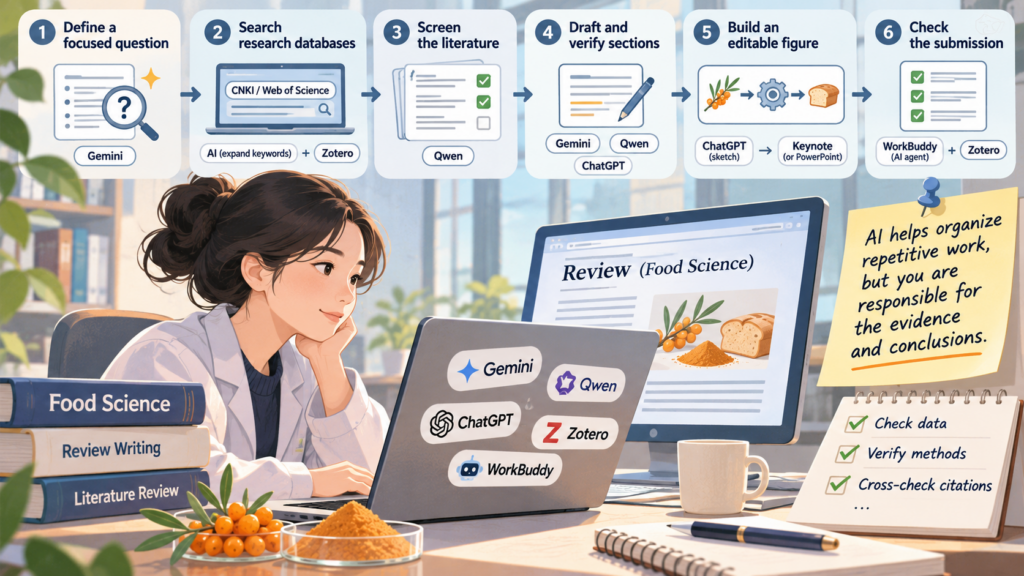
In a November 13, 2026 article for SSPAI, food-science graduate student Hu La Tu Shuo describes a workflow used while preparing a review paper that was accepted by Food Science and published online. It is a personal account, not a tested method for every discipline. The author’s central distinction is that AI can help organize repetitive work, but the researcher remains responsible for the evidence and conclusions.
The workflow moves through six stages:
- Define a focused question. After reading recent reviews, the author used Gemini to explore topics, identify possible gaps and draft an outline. The chosen subject concerned ways to improve the use and sensory qualities of sea buckthorn pomace in flour-based products. The author then checked and revised the proposed structure.
- Search research databases. AI helped expand Chinese and English keywords and draft searches for CNKI and Web of Science. The author ran the searches in the databases and selected relevant papers for Zotero; AI-generated search terms were not treated as search results.
- Screen the literature. The author exported Zotero item reports containing titles, authors and abstracts, then used Qwen to help rank relevance and extract reported methods and findings. The suggested batch size was about 15–20 papers. Abstracts helped with initial screening, but missing experimental details still required reading the full papers.
- Draft and verify sections. Gemini and Qwen helped organize chapter drafts around research questions and comparisons rather than paper-by-paper summaries; ChatGPT was also used for editing against key sources. The author checked numerical claims, terminology, methods and conflicting findings against the literature.
- Build an editable figure. ChatGPT generated an initial mechanism-diagram sketch. The author checked its arrows, labels and depicted steps against the reviewed material, then recreated the figure in Keynote. PowerPoint was suggested as an alternative for Windows users. The article warns that an AI sketch may contain incorrect or invented elements.
- Check the submission. Zotero metadata and journal formatting needed further review. The author used the local AI agent WorkBuddy to help inspect citation order, references, figures and formatting in a document copy, while calling for a report and human approval before changes. Any proposed corrections—including bibliographic details—still need verification against the sources and the journal’s requirements.
The practical lesson is not to delegate scholarly judgment: a plausible outline, summary, diagram or citation is a starting point for checking, not evidence that the underlying research is correct.