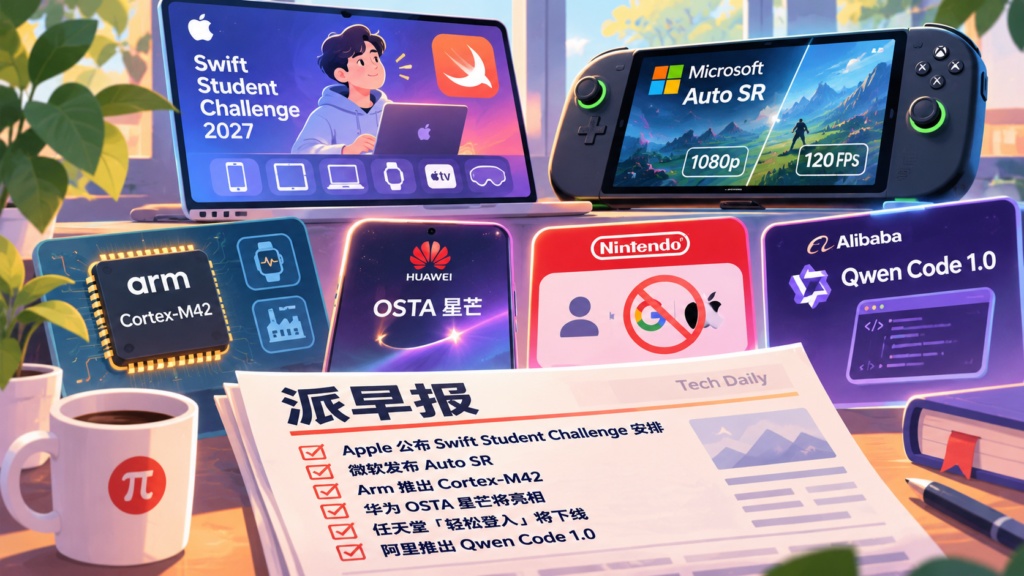
Apple has set the submission window for its 2027 Swift Student Challenge for February 8–28, 2027. Students can submit an app for any Apple platform, including iOS, iPadOS, macOS, watchOS, tvOS and visionOS; previous challenges focused mainly on iPhone and iPad.
Entries must be independently made Xcode apps or Swift Playground app playgrounds, submitted as ZIP files no larger than 500 MB and designed for an experience of no more than three minutes. They must work without an internet connection, use Xcode 27 or Swift Playground 4.7 or later, and have English-language content. Entrants must be students or eligible recent graduates with Apple developer accounts; full-time developers cannot enter. Entrants in mainland China must be at least 14. Apple has also scheduled three online preparation sessions for December 10, January 14 and February 4. Winners will receive a one-year Apple Developer Program membership and a gift; distinguished winners will be invited to Apple’s campus for WWDC 2027.
Microsoft’s Automatic Super Resolution (Auto SR) was announced on November 10 for Xbox Ally X, Xbox Ally X20 and select Windows Copilot+ PCs with AMD Ryzen processors. The release adds handheld use on battery power and support for 1080p games; an earlier test on Xbox Ally X required the device to be docked. Microsoft also introduced a performance mode that raises the stated frame-rate ceiling from roughly 60–75 FPS to 120 FPS. Users can switch between quality and performance modes in Xbox Game Bar. According to Microsoft’s DirectX blog, setup requires updates to Xbox Game Bar and Windows 11, plus the Auto Super Resolution Package from Microsoft Store; the controls are under Widgets → Display → Graphics in Xbox Game Bar.
Other announcements in the November 12 roundup:
- Arm introduced Cortex-M42 on November 10. Aimed at cost- and area-sensitive devices such as wearables and industrial controllers, it uses Armv8.1-M, Helium technology and a compact AHB bus design. Arm says its vector-computing performance can reach up to three times that of Cortex-M33, with up to twice the vector-computing energy efficiency. Arm added the processor to its Flexible Access and Total Access licensing programs.
- Huawei’s OSTA Xingmang sub-brand will make its public debut at a November 20 event, Huawei consumer-business chairman Yu Chengdong said on November 11. An OSTA Xingmang phone Weibo account had appeared but had not posted content.
- Nintendo will discontinue Nintendo Account’s “Easy Login” feature at 15:00 Beijing time on January 26, 2027, it announced on November 10. Afterward, creating an account using Google or Apple account information will no longer be supported, and the Google-account-linked task in the My Nintendo points program will end. Existing users who encounter a sign-in screen after that date can use the email address or ID linked to their Nintendo Account, or a passkey.
- Alibaba announced Qwen Code 1.0 on November 11, combining Qoder and Qwen Code in an open-source release. Alibaba says the separately available 1.0 Preview branch brings agent-runtime capabilities developed in Qoder into Qwen Code, while the existing stable branch remains available. Its proposed architecture uses a unified event model to separate access, scheduling and execution as it evolves from a single process toward multiple nodes.