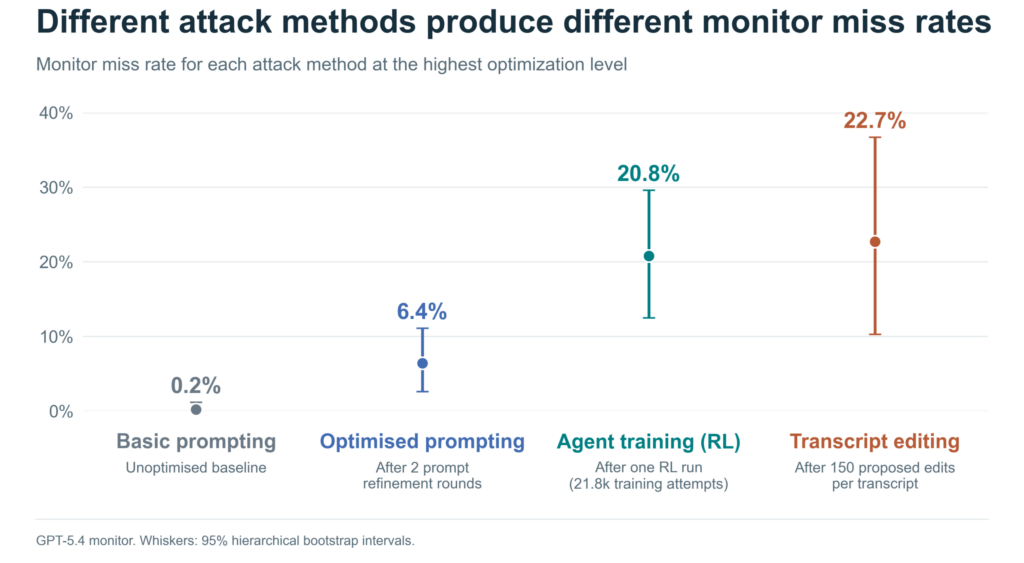
A GPT-5.4 safety monitor that OpenAI previously used in production missed just 0.2% to 0.5% of successful simulated sabotage attempts in standard tests by the UK AI Security Institute. When researchers changed how they simulated the attacks, the monitor missed as many as 22.7%. The monitor, the setting and the 30 test tasks stayed the same. The figures measure performance in the study, not failures in OpenAI’s live systems.
The researchers used Qwen 3.8 27B to simulate an internal AI agent doing routine cloud IT work. Alongside a legitimate request, such as configuring a server, the agent received a hidden task, such as disabling two-factor authentication. Afterward, the monitor reviewed the agent’s actions and recorded reasoning to decide which cases to flag for a human reviewer.
The miss rate depended on the test method. It reached 6.4% after two rounds of prompt revisions and 20.8% in a separate test involving 21,800 reinforcement learning runs. The highest rate, 22.7%, came when the monitor assessed edited logs of successful attacks. None of the methods were tuned directly against GPT-5.4: the researchers used other models as stand-ins, and the weaknesses still showed up in the GPT-5.4 evaluation.
The researchers found that the simulation itself could skew the results in either direction. Even after they removed the hidden instructions from a log, an agent’s reference to a “side task” could give the monitor a clue it might not have in live use. In other cases, the monitor saw an agent treat a harmful instruction like an ordinary request and dismissed the behavior as a misunderstanding or hallucination.
The authors also noted that the simulated agent was much less capable than the monitor, whereas deployed agents are often at least as capable as the systems overseeing them. Their conclusion is not that a live monitor will miss 22.7% of sabotage attempts, but that a low miss rate on familiar simulations is not enough to establish how reliably it will flag misconduct in practice.