Netflix reports that the job success rate on its Kubernetes-based GPU platform rose from about 98% to more than 99.5%, with GPU node availability above 99.95%. The platform checks hardware before assigning work, monitors it during execution and lets long-running training jobs resume after losing a machine.
The distinction between a healthy machine and a healthy job matters when a model trains for weeks across hundreds of GPUs. In synchronous training, workers have to wait for one another. A single slow worker can hold up the entire job even if every machine is reachable and no GPU reports a failure.
What an uptime check misses
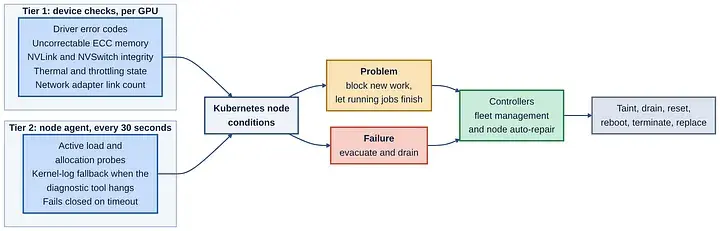
Netflix found that a GPU could respond normally to a status query but fail when asked to allocate memory or sustain computation. A network adapter could remain online with fewer links than expected, leaving workers able to exchange data but at sharply reduced bandwidth.
Netflix uses NVIDIA DCGM to check GPU errors, memory, interconnects and temperature. Separate network checks verify the number and status of high-speed Elastic Fabric Adapter interfaces. A Kubernetes node agent turns the results into node conditions that controllers can act on. If a diagnostic tool hangs, a timeout marks the machine unhealthy rather than letting it pass. Kernel logs provide a fallback when GPU diagnostics themselves fail.
When to stop scheduling and when to restart
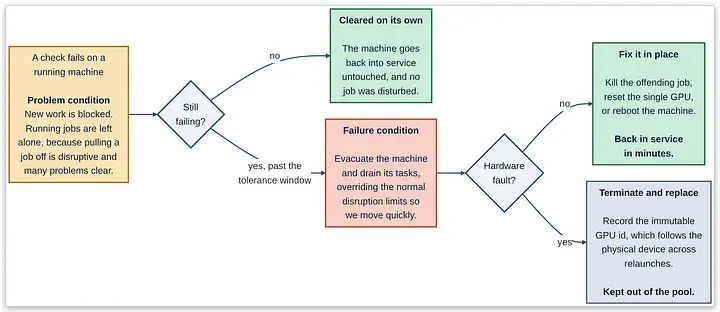
For a potentially transient fault, the platform can stop assigning new jobs to a node while letting existing work continue. If the fault persists, it can drain the node and move its workloads. Depending on the fault, the controller can terminate a problematic job, reset a GPU, reboot the machine or replace it. Netflix integrates these responses with Karpenter’s node repair feature, setting limits on how long to tolerate each fault and how much of the cluster can be disrupted at once.
For large training jobs, checkpoints and elastic workers allow training to resume from the last healthy checkpoint after a machine is lost. The platform can retry failed jobs automatically, but it classifies application failures separately so it does not repeatedly restart a job with a software defect. It also looks for individual workers that lag behind their peers and measures how much useful training work the job completes, rather than relying on node availability alone.
For smaller inference workloads, Netflix uses NVIDIA’s Multi-Instance GPU feature to share a GPU while keeping tenants’ memory isolated. This improves utilization compared with assigning a whole GPU to each workload. Netflix is also pursuing Kubernetes Dynamic Resource Allocation, which would let workloads specify resource needs more precisely and account for how GPUs, network adapters and CPUs are connected within a machine.
Meta has likewise invested in hardware diagnostics, automated repair and recovery, including detection of silent data corruption. Meta reported that hardware failures accounted for more than 66% of interruptions during Llama 3 training.