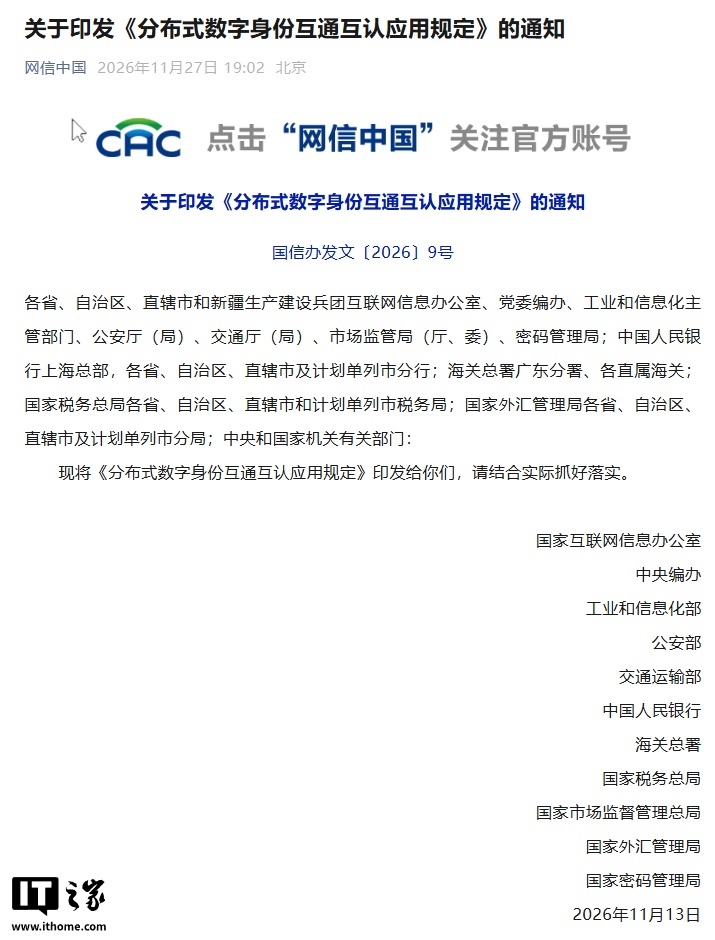
China’s Cyberspace Administration and 10 other departments have issued rules on how distributed digital identities are registered, issued and verified so they can be recognized across regions, industries and platforms. According to a November 27, 2026 report citing the administration’s official WeChat account, the rules take effect on March 1, 2027. Registration is voluntary.
A distributed digital identity uses technologies such as blockchain and lets users manage their own identity information. It consists of an identifier, keys, verifiable credentials and verifiable statements. Users can use it to manage digital accounts, sign in or authorize the use of data.
Privacy limits. Application service providers must minimize the information they collect. They must not unnecessarily link or aggregate a user’s identity identifier with other account data they hold about that user. They also must not analyze identity verification activity across contexts for unrelated purposes such as profiling or targeted marketing.
Registration and credentials. Public identity services will run on an identity chain built on China’s national blockchain network and operated by an entity authorized by the national cyberspace authority. The rules distinguish between domestic and overseas identities. For domestic identities, verification depends on who or what is being registered:
- For individuals, the State Council’s public security department verifies identity through channels including the national public online identity authentication service. The identity is then issued through the chain.
- Government agencies and public institutions apply to the central authority responsible for institutional organization and staffing to verify their identity data.
- Legal entities and other organizations apply to the authority responsible for unified social credit codes.
- For industrial equipment and goods, the State Council’s industry and information technology department handles registration and verification through the industrial internet identifier resolution system.
Government agencies, enterprises, public institutions and social organizations can join the chain as credential issuers. Users can request credentials attesting to specific attributes or issue their own credentials to authorize data use or allow someone to act on their behalf. A verifier can check a credential’s authenticity and validity through the chain. Users decide whether to apply for, hold, use or deactivate their identities and credentials.
Potential uses. The rules encourage mutual recognition between digital yuan identity services and distributed digital identity services. They also identify online tax identification, electronic transport tickets, customs services and identity checks for public-resource tenders as possible applications, and encourage the use of distributed identities to identify AI agents. These are encouraged uses, not mandatory integrations.