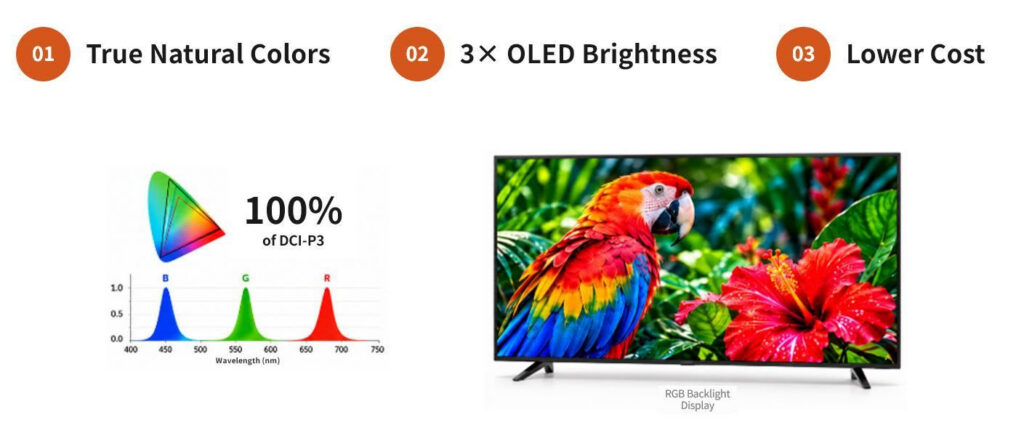
Seoul Semiconductor said on November 25, 2026, that it had begun full-scale mass production of its WICOP Pixel RGB backlight and was expanding supply to TV manufacturers worldwide. Developed by its subsidiary Seoul Viosys, the technology replaces the conventional white backlight while retaining a standard LCD panel.
Each WICOP Pixel unit combines red, green and blue chips without a separate package. The chips are spaced at a pitch of several tens of micrometers. Controlling the three colors independently allows the backlight to produce tens of thousands of colors, according to the company.
Seoul Semiconductor says an LCD using the backlight can reproduce the full DCI-P3 digital cinema color gamut and reach a peak brightness of up to 3,000 nits. The company says that brightness can help images remain clear in a brightly lit living room or public space. It claims more than three times the brightness and more than twice the lifespan of OLED, but did not identify the OLED displays or test conditions used for those comparisons.
To expand production, Seoul Semiconductor plans to convert existing white-backlight production capacity rather than make large new investments. It reported that third-quarter display-related revenue rose nearly 20% year over year. The company is also researching whether it can eliminate the color filter, which it estimates accounts for about 20% of LCD panel material costs. Filter removal is not a feature of the backlight now in production.
Market research firm Omdia expects global shipments of RGB-backlit TVs to reach about 7 million units by 2030, led by large premium models. It forecasts that the category as a whole, not WICOP Pixel alone, will account for more than 10% of global TV market revenue by then.