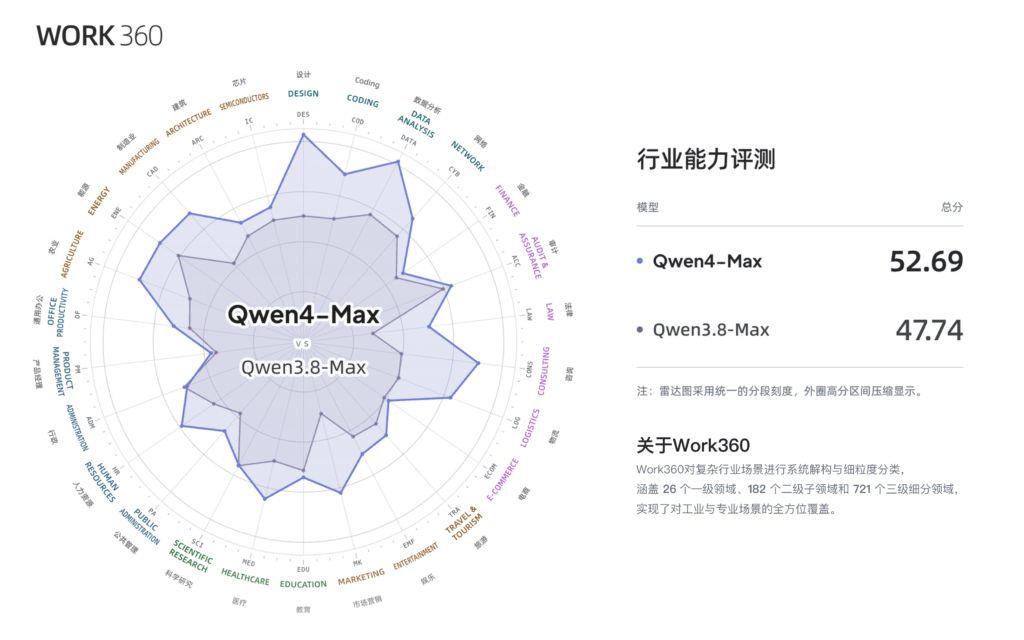
Alibaba introduced Qwen4-Max on November 16, 2026, according to a report published November 17. The company says the model has 2.4 trillion total parameters, activates 71 billion per token, supports a context window of up to one million tokens, and has native visual capabilities. It is available through the Qwen AI platform’s API, Alibaba Token Plan, and applications including Qwen Office, Qoder and the Qwen app.
Alibaba says the model’s new mixture-of-experts architecture uses Qwen Sparse Attention. Compared with its predecessor, Qwen3.8-Max, it activates 25% fewer parameters per token. In the company’s reported Terminal-Bench 4.0 results, at the same “Xhigh” reasoning setting, average token use per attempt fell from 289,000 to 151,000 while the score rose from 38.9 to 48.5. Alibaba also reports a 58% reduction in average cost per task in that evaluation. Its API price can be as low as 0.5 yuan per million tokens when the cache is hit; that is not a general price for all API use.
The reported benchmark results include sixth place for Qwen4-Max in CodeArena’s Webdev ranking, a score of 46.7 on Agents’ Last Exam, and 54.2 on Chartography. Alibaba also reports scores of 68.5 on JobBench and 21.3 on the legal-task benchmark HLAB-Vals-1.1. These are reported results, not independent tests conducted for this article.
Alibaba describes a “Live Delivery” feature that produces an initial usable version of a project and revises it in response to feedback. In one example it provided, the model delivered 14 versions of an educational physics website. The company also claims applications in manufacturing, finance and research: it says an automotive machining-programming workflow reduced manual time per workpiece from 475 to 24 minutes, and describes experiments involving a newly synthesized coolant material and candidate molecules for an Alzheimer’s disease target. Those examples are company-reported claims, not evidence of broad deployment or validated scientific outcomes.
Alibaba says smaller models in the Qwen4 series will be released as open source later; the report does not give a release date.