Reported by InfoQ on November 12, 2026, from the 2026 Baidu World Conference.
Baidu founder Robin Li posed a question for companies adopting AI: Why is token spending rising without a corresponding increase in revenue or profit? His answer was that adding AI tools to existing work is not enough. Companies, he argued, need to redesign workflows so people and AI agents can carry out tasks together.
Li described three principles for that shift: organize work around tasks rather than rigid job boundaries; make employees’ hard-to-document knowledge reusable by colleagues and agents; and build measurable feedback loops that improve processes over time. These are his proposals for organizational change, not evidence that AI spending has already improved business results.
As an example of Baidu’s own adoption, Li said its daily active agents had risen from about 5,000 to 37,000 over the past year, while weekly effective work tasks grew from 84,000 to more than 1 million. He also acknowledged missteps: business units separately fine-tuned models that fell behind as base models improved, and teams spread resources across too many agent projects. Baidu subsequently centralized model training and began monthly reviews to narrow project priorities, he said.
Lenovo chair and CEO Yang Yuanqing told the conference that enterprise AI adoption needs both top-down planning and bottom-up experimentation. He described AI uses across Lenovo’s development, sales, service and supply-chain work, but said people still need to judge and act on AI-generated forecasts.

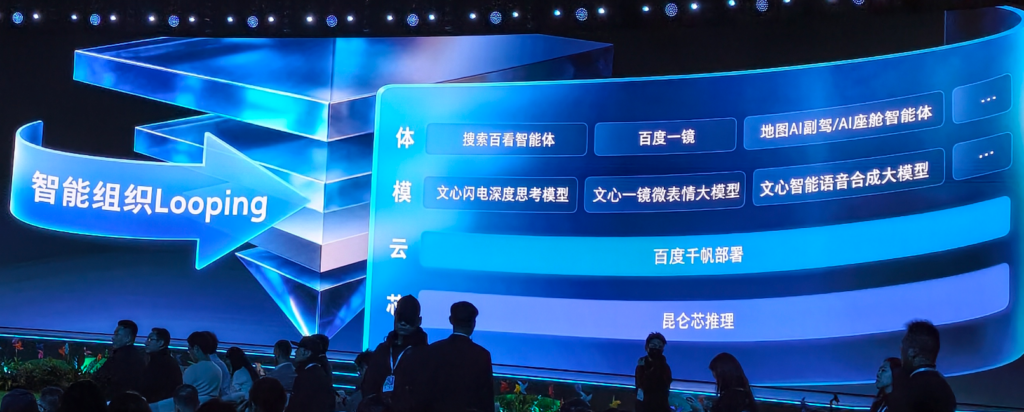
Baidu also presented products intended to support its “intelligent organization” approach. It said its Dazi assistant now connects to its professional agents and offers an Agent API for integration with business systems. In a Baidu-reported evaluation covering seven types of work scenario and nearly 100 cases, its first-pass acceptance rate on complex, cross-system tasks rose from 67.6% to 88.2%. Those figures are Baidu’s reported results, not an independent assessment.
Other announcements included Famou 3.0, positioned as an agent platform paired with deployment-engineering services, and Ciyuansuo, a model marketplace that Baidu says checks model provenance and monitors service quality. At the infrastructure level, Baidu introduced the ERNIE 5.5 Flash Preview model and said its Kunlun M100 chip was on the market. It plans to launch the M300 chip and bring its Tianchi 1,024-card supernode to market in 2027.
The practical question behind the announcements remains the one Li opened with: whether integrating agents into measurable business processes can produce returns that increased AI usage alone has not demonstrated.
Source: infoq.cn (originally published 2026-11-12 10:45 UTC+8)