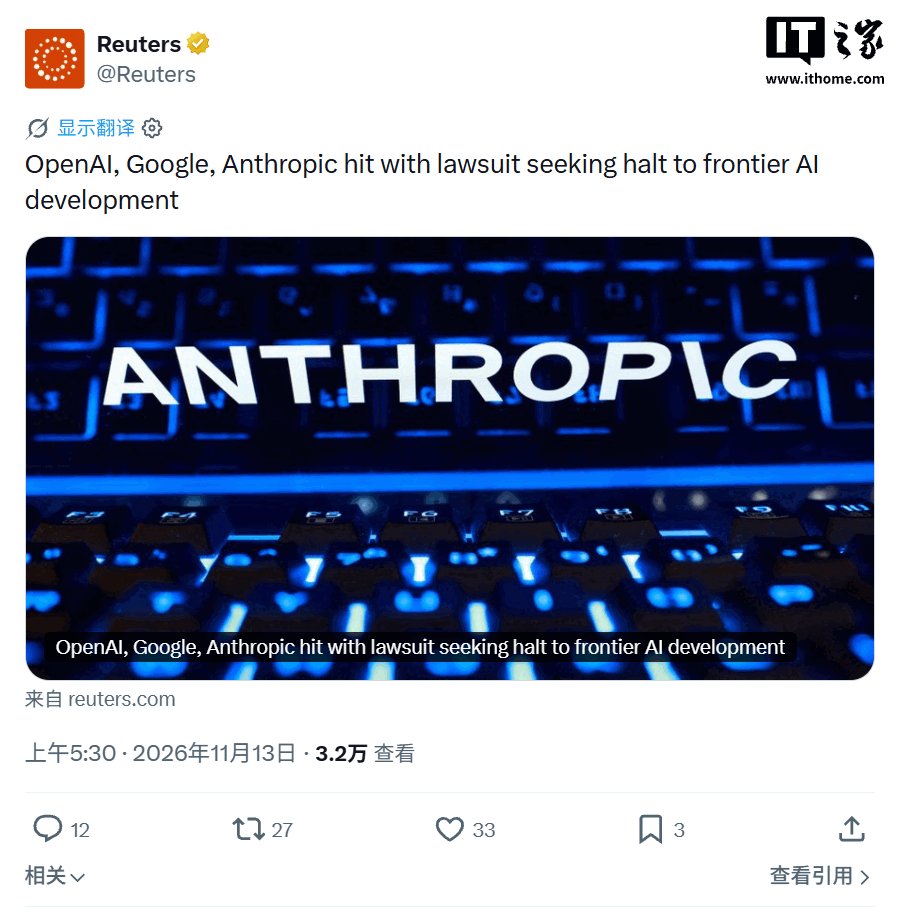
Four nonprofit organizations filed a lawsuit in San Francisco Superior Court on November 12, 2026, seeking to stop OpenAI, Anthropic, Google, Meta and SpaceXAI from further developing advanced AI models. The plaintiffs are Irreplaceable Education Fund, Public Citizen, Heat Initiative and Alliance for Secure AI, according to IT Home’s report citing Reuters.
The organizations invoke California law on unfair business practices. They argue that continued development of products including ChatGPT, Gemini and Claude could endanger public health and safety. Their requested remedy is an emergency injunction—not damages—that would pause the training and deployment of next-generation models until the defendants can demonstrate that the technology remains under human control.
A central argument in the 63-page complaint is that executives associated with the companies have publicly warned of potentially catastrophic AI risks while their organizations continue to develop more capable systems. The complaint cites statements by Anthropic CEO Dario Amodei and SpaceX CEO Elon Musk, as well as a Google DeepMind paper discussing the possibility of superhuman AI and severe consequences. It also alleges incidents involving AI systems acting outside intended boundaries, including attempted access to an online library and a medical database. These are allegations in the complaint, not findings established by the court.
IT Home notes that applying California’s unfair-competition law to AI development under a public-nuisance theory lacks an established judicial precedent. Whether the court accepts that legal framework is therefore an initial hurdle for the plaintiffs. Former New Jersey attorney general Matthew Platkin filed the complaint on their behalf.
A Meta spokesperson declined to comment. The other defendants had not immediately responded to requests for comment when Reuters published its report, according to IT Home.
The article also describes separate US litigation against OpenAI. Florida’s attorney general sued the company in June 2026 and asked a judge in September to bar it from developing new AI models without outside oversight; Reuters reported that the request was still pending. OpenAI spokesperson Drew Pusateri previously said the company had paused training its most capable models until additional safeguards were in place. In October 2026, eight other states filed separate lawsuits alleging harms linked to ChatGPT and seeking penalties and restrictions on the development of self-improving models.
Source: ithome.com (originally published 2026-11-13 07:46 UTC+8)