Ant Digital (蚂蚁数科) says its LingDT-Decision model now supports information extraction on the System One protocol, for industrial decisions that need values such as amounts and dates taken from context rather than only a choice among preset options.
An InfoQ China article published on 11 November 2026 says decision models represented by Jev can handle single-choice and judgment-style questions, but not extraction tasks that those workflows also require. LingDT-Decision adds a native extract question type. Ant Digital says mid-training, reinforcement learning and other techniques adapt the model to accuracy and efficiency requirements, and that its extraction results already exceed generative models of the same size and of larger sizes, with advantages in speed and inference reliability. The article presents those comparisons as the vendor’s evaluation; it does not include independently reproduced measurements.
What a choice model does not extract
The article uses a support ticket: “订单 A123 多扣了 199 元,退款等了一周还没到。” (Order A123 was overcharged 199 yuan, and the refund has been pending for a week.)
A System One-style choice request places that text in state and asks which team should handle the ticket, with three options:
- billing: charges, bills or refunds
- shipping: logistics, parcels or delivery
- account: login or account settings
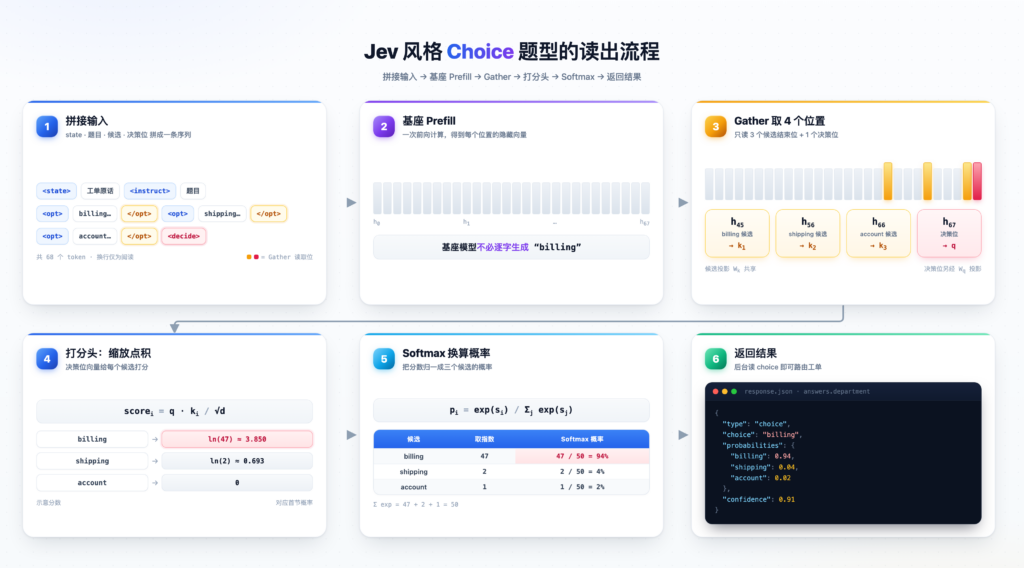
An illustrative response — the article says the probabilities and confidence are example values, not a measured run — selects billing, with probabilities 0.94, 0.04 and 0.02 and confidence 0.91. A backend can route the ticket from answers.department.choice.
The “199 yuan” figure is different. It is an open value, so choice, judgment or scoring does not extract it. The article says System One, as designed, currently struggles with this class of problem. With LingDT-Decision’s extract type, the application names the field to find, and the model is meant to return the matching source fragment and its position so “199 元” can be highlighted in the ticket.
How Jev’s open-source path scores an answer
Using Kev, described as Jev’s open-source implementation, the article splits answer reading into: concatenate the input, prefill the base model, take hidden vectors at specific tokens, score the target tokens, and return probabilities.
For a choice question, the sequence places the ticket after a state marker, then the instruction, then each option’s name and description, and ends at a decide marker. The article writes these with readable tags such as <state>, <instruct>, <opt> and <decide>, and notes that the actual special tokens depend on the base model.
After one forward pass, Choice, Score and Noul questions use vectors at the candidate end positions and at the final decide position. The decide vector is linearly projected to a query q. Each candidate-end vector passes through the same candidate projection to keys k₁, k₂ and k₃. A scoring head takes the scaled dot product of q with each key, then converts those scores into option probabilities in a task-specific way.
From choosing an option to locating a span
LingDT-Decision keeps that path for extraction. The concatenated request includes prior context, an instruction to extract predefined entity types, the source text, a slot definition and a decide marker. In the example, the slot is overcharge_amount: the amount overcharged on the order, keeping the original unit.
After prefill, the model uses vectors for the decide and slot positions and for every token inside the context, because the label is predicted per token.
The extraction head gives each source token three scores: B for the beginning of a span, I for a continuation inside the span, and O for outside it. A softmax over B, I and O at that token produces the label probabilities. Unlike choice, which assigns probability to each option, these probabilities are computed at each position in the source text.
Reported results
The article says LingDT-Decision adds native information extraction and multi-select, and uses mid-training, reinforcement learning and OPD to align with real enterprise scenarios. It does not define OPD.
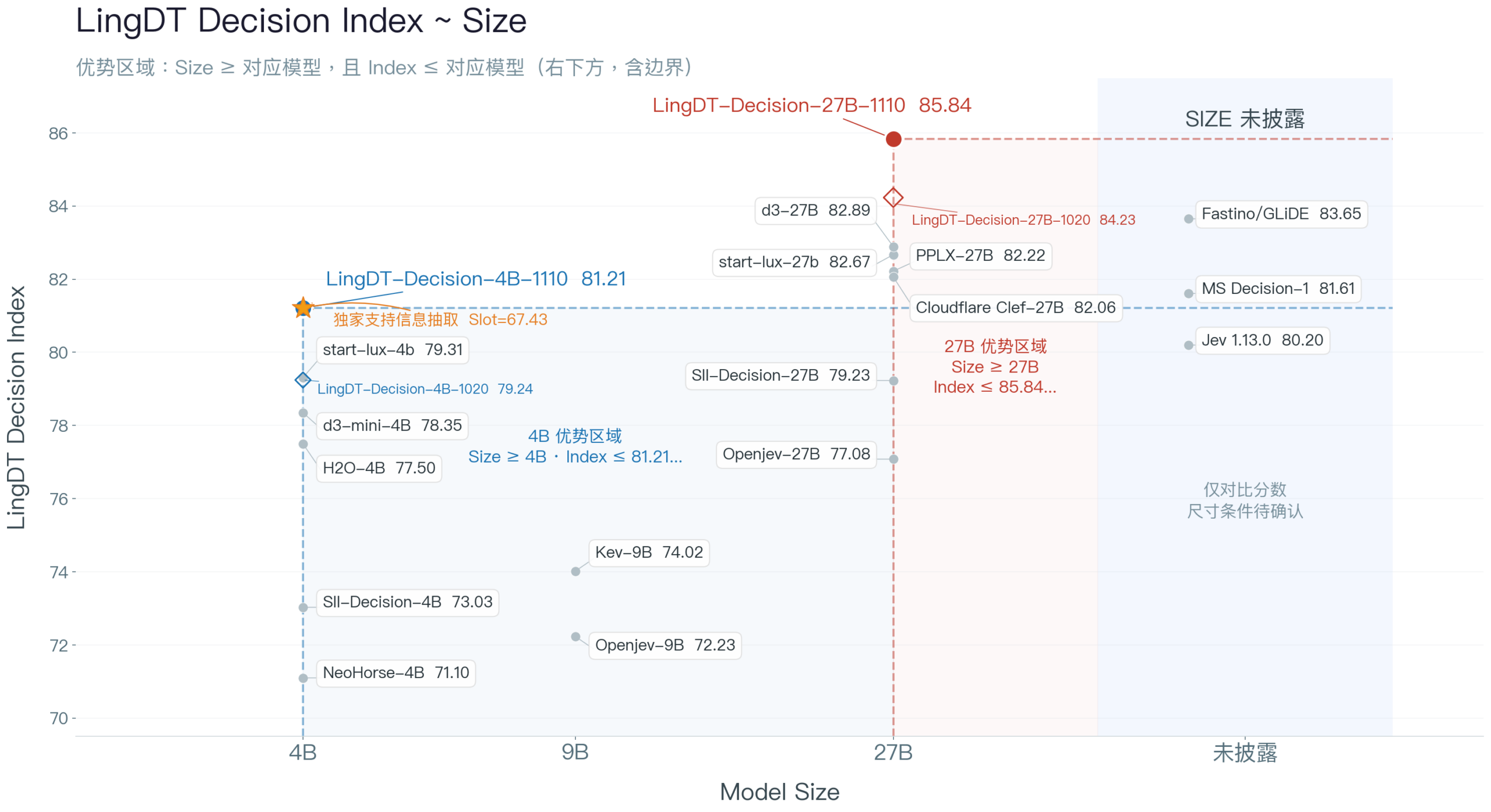
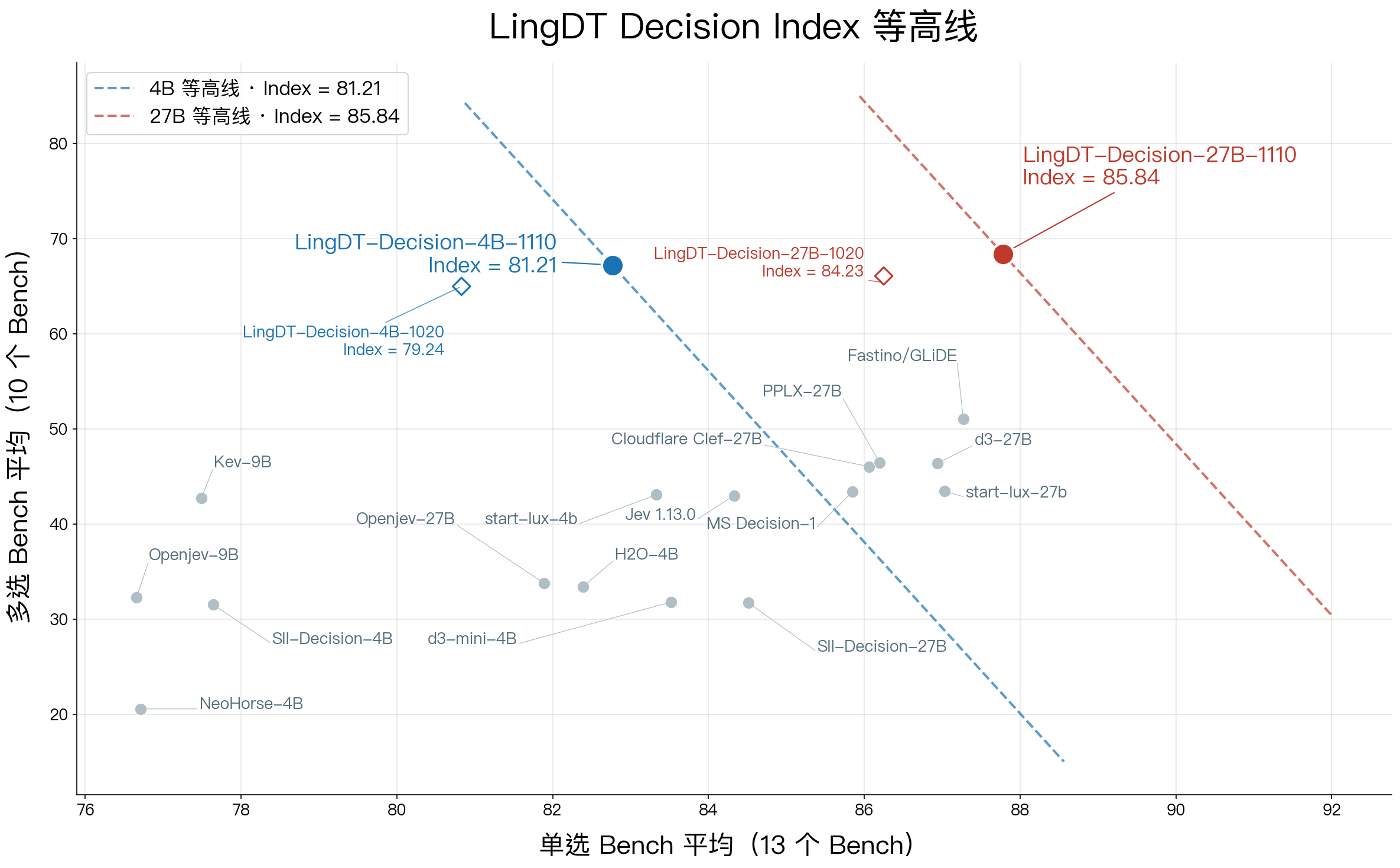
On 23 open evaluation benchmarks, it reports a higher overall score than popular decision models including Microsoft-Decision-1 and Jev 1.13, and says the 27B version has the highest accuracy among models of the same parameter scale. A chart compares advantage regions for the 4B and 27B versions with related sizes of models including Jev, MS Decision and GLiDE.
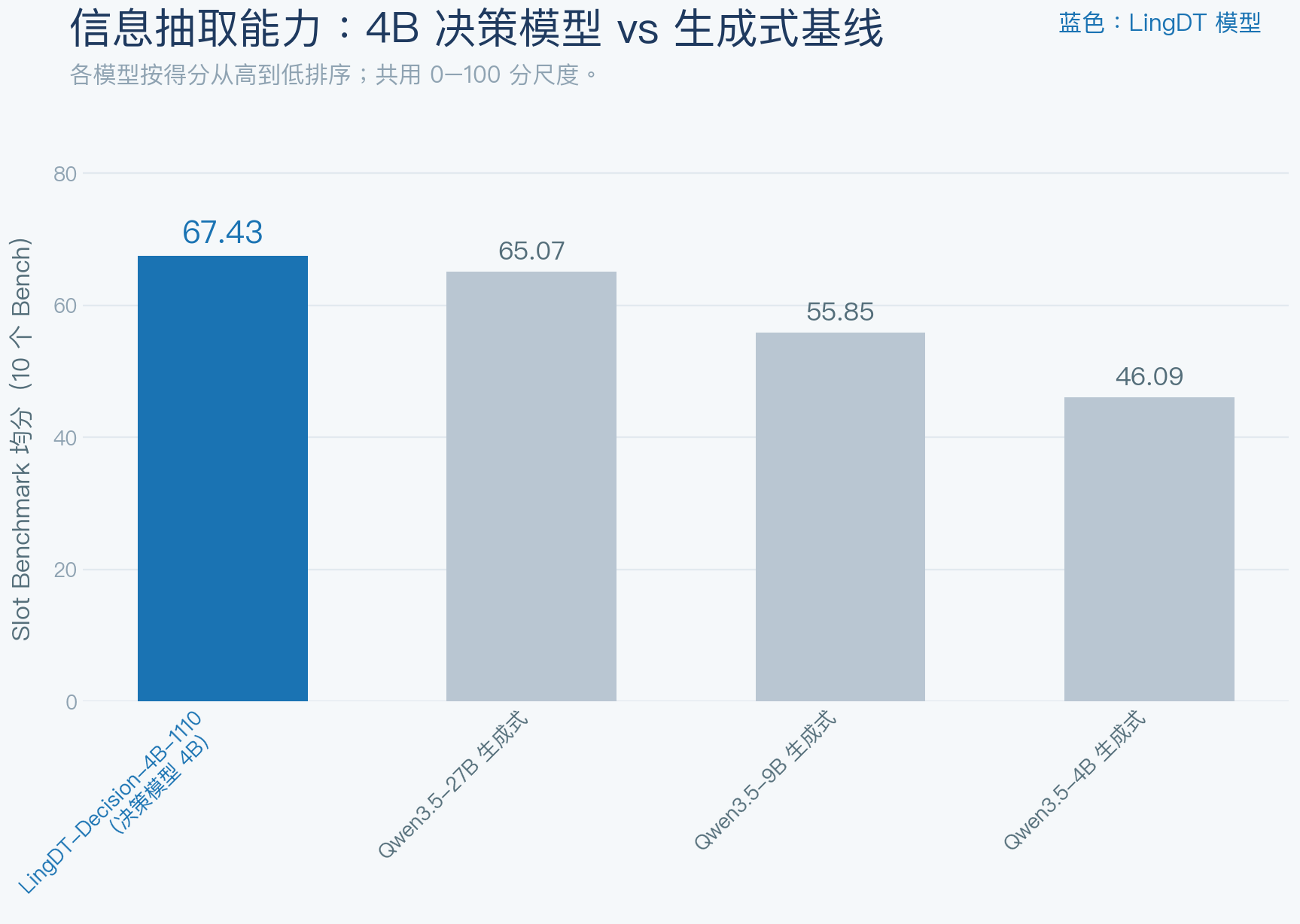
On 10 typical information-extraction benchmarks, the article says overall performance exceeds same-size and larger generative models, again citing speed and inference reliability. The chart average is described as macro F1 across those datasets. The article text does not list per-dataset scores.
On the 23 benchmarks, the 27B composite — 90% of the single-choice score plus 10% of the multi-choice score — is reported first, ahead of Microsoft-Decision-1, Jev 1.13.0 and Fastino/GLiDE, among others. On multi-select, both the 4B and 27B versions are said to exceed 16 decision models, including Microsoft-Decision-1, Jev 1.13.0 and Star-lux. The article presents that as an advantage of native multi-select on multi-label and combination decisions. On single-choice, it places the model in the first tier rather than claiming a sole lead.
Sample extract call
The article’s sample request sets type to extract, instructs the model to extract the overcharged amount, defines overcharge_amount as that amount with its original unit, and passes the ticket as context. The sample answer is one span:
- type:
overcharge_amount - text:
199 元 - start: 12
- end: 17
Those offsets apply to the original Chinese ticket string in the example.
LingDT-Decision is available on Ant Digital’s DTMaaS platform, and the article says the Slotting feature can be tried at no charge through DTMaaS’s public call examples. The article text does not give a separate endpoint URL.
Original article: InfoQ China